Advertisements
Advertisements
Question
A motor bike running at 90 kmh−1 is slowed down to 18 kmh−1 in 2.5 s. Calculate
- acceleration
- distance covered during slow down.
Advertisements
Solution
Initial velocity of motor bike = u = 90 kmh−1
= u = `90xx5/18` ms−1 = 25 ms−1
Final velocity of motor bike = v = 18 kmh−1
v = `18xx5/18` ms−1 = 5 ms−1
Time = t = 2.5 s
(i) Acceleration = a = ?
v = u + at
5 = 25 + a (2.5)
2.5a = −25 + 5 = −20
a = `(-20)/2.5` = −8 ms−2
(ii) Distance covered S =?
v2 − u2 = 2aS
(5)2 − (25)2 = 2(−8)S
25 − 625 = −16S
−16S = −600
S = `600/16`
S = 37.5 m
APPEARS IN
RELATED QUESTIONS
Distinguish between acceleration and retardation.
A train starts from rest and accelerates uniformly at a rate of 2 m s−2 for 10 s. It then maintains a constant speed for 200 s. The brakes are then applied and the train is uniformly retarded and comes to rest in 50 s. Find
- The maximum velocity reached,
- The retardation in the last 50 s,
- The total distance travelled,
- The average velocity of the train.
A car travels with uniform velocity of 25 m s-1 for 5 s. The brakes are then applied and the car is uniformly retarded and comes to rest in further 10 s. Find:
- The distance which the car travels before the brakes are applied,
- Retardation and
- The distance travelled by car after applying the brakes.
From the velocity – time graph given below, calculate deceleration in region BC.
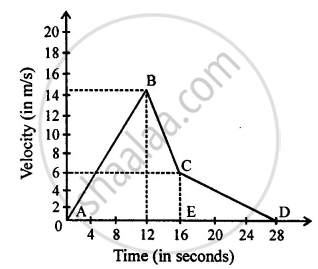
An aeroplane lands at 216 kmh−1 and stops after covering a runway of 2 m. Calculate the acceleration and the time, in which it comes to rest.
A motor bike running at 5 ms−1, picks up a velocity of 30 ms−1 in 5s. Calculate
- acceleration
- distance covered during acceleration.
Can you use the relation [B1]?
A body has an acceleration of -3.5 ms-2. What is its retardation?
A car accelerates to a velocity of 30 m/s in 10 s and then decelerates for 20 s so that it stops. Draw a velocity-time graph to represent the motion and find:
Distance travelled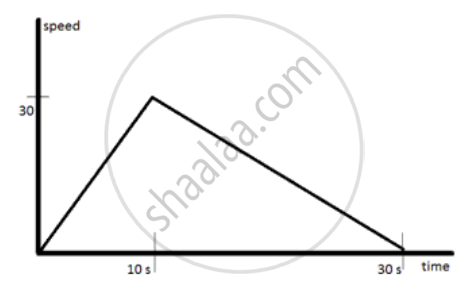
What do you mean by constant acceleration?
