Advertisements
Advertisements
Question
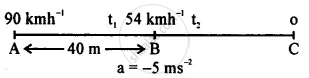
A motorbike running at 90 kmh−1, is slowed down to 54 kmh−1 by the application of brakes, over a distance of 40 m. If the brakes are applied with the same force, calculate
- total time in which bike comes to rest
- total distance travelled by bike.
Advertisements
Solution
Initial velocity = u = 90 kmh−1
= u = `90xx5/18` ms−1 = 25 ms−1
Final velocity = v = 54 kmh−1 = `54xx5/18` ms−1
v = 15 ms−1
Distance = S = 40 m
v2 = u2 + 2as
(15)2 = (25)2 + 2 ⋅ a ⋅ 40 ⇒ 225 = 625 + 80a ⇒ 80a = 225 − 625 = −400 ⇒ a = `(-400)/80`
a = −5 m/s2
v = u + at ⇒ 0 = 25 + (−5)t ⇒ t = `25/5` = 5 seconds
v2 = u2 + 2as ⇒ 0 = (25) 2 + 2 ⋅ (−5) ⋅ s ⇒ 625 = 10s ⇒ s = `625/10` = 62.5 m
Total time to stop = 5 seconds
Total distance before stopping = 62.5 m
APPEARS IN
RELATED QUESTIONS
Fill in the following blank with suitable word :
Displacement is a…………………… quantity whereas distance is a………………………….
The displacement of a moving object in a given interval of time is zero. Would the distance travelled by the object also be zero ? Give reason for your answer.
Draw a velocity-time graph for a body moving with an initial velocity u and uniform acceleration a. Use this graph to find the distance travelled by the body in time t.
The following table gives the displacement of a car at different instants of time.
| Time (s) | 0 | 1 | 2 | 3 | 4 |
| Displacement (m) | 0 | 5 | 10 | 15 | 20 |
- Draw the displacement-time sketch and find the average velocity of the car.
- What will be the displacement of the car at (i) 2.5 s and (ii) 4.5 s?
Define Distance.
Under what condition is the displacement of a body equal to the distance traveled by it?
Calculate the distance and displacement in the following case: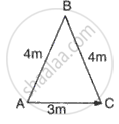
An object is thrown vertically upwards. It rises upto a height H and then returns to its initial position. Calculate
The displacement of the object.
Is distance covered during nth second more than the distance covered in n seconds?
A 50 m long train passes over a bridge at a speed of 30 km/h. If it takes 36 seconds to cross the bridge, calculate the length of the bridge.
