Advertisements
Advertisements
Question
A motor car slows down from 72 kmh−1 to 36 kmh−1 over a distance of 25 m. If the brakes are applied with the same force
calculate
- total time in which car comes to rest
- distance travelled by it.
Advertisements
Solution

Take motion of a car from A to B:
u = 72 kmh−1 = `72xx5/18` ms−1
u = 20 ms−1
v = 36 kmh−1 = `36xx5/18` ms−1
v = 10 ms−1
(Time) t1 = ?
Acceleration = a = ?
Distance = S1 = 25 m
v2 − u2 = 2aS1
(10)2 − (20)2 = 2a (25)
50a = 100 − 400 = −300
a = `-300/50` = −6 ms−2
Now, v = u + at1
10 = 20 + (−6) t1
6t1 = 20 − 10 = 10
t1 = `10/6` = 1.67s
Take motion of a car from B to C:
u = 36 kmh−1 = 10 ms−1
v = 0
a = −6 ms−2
(Time) t2 = ?
(Distance) S2 = ?
v = u + at2
0 = 10 + (−6) t2
6t2 = 10
t2 = `10/6` = 1.67S
Now, v2 − u2 = 2aS2
(0)2 − (10)2 = 2 (−6) S2
−12S2 = −100
S2 = `100/12` = 8.33 m
Total time taken by car from A to C = t1 + t2 = `10/6+10/6`
= `(10+10)/6=20/6` = 3.33s
Total distance covered by car from A to C = S1 + S2
= 25 + 8.33 = 33.33 m
APPEARS IN
RELATED QUESTIONS
A farmer moves along the boundary of a square field of side 10 m in 40 s. What will be the magnitude of displacement of the farmer at the end of 2 minutes 20 seconds?
A body starts from rest with uniform acceleration 2 m s-2. Find the distance covered by the body in 2 s.
A racehorse runs straight towards the north and covers 540 m in one minute. Calculate
- displacement of the horse,
- its velocity in (a) ms−1 (b) kmh−1.
Can you suggest the kind of motion of a body from the following distance – time graph?
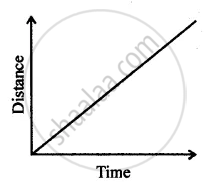
An object is thrown vertically upwards. It rises upto a height H and then returns to its initial position. Calculate
The total distance traveled by the object
The graph shows how the velocity of a scooter varies with time in 50 s.
Work out: The distance traveled in 10 s, 20 s, and 50 s.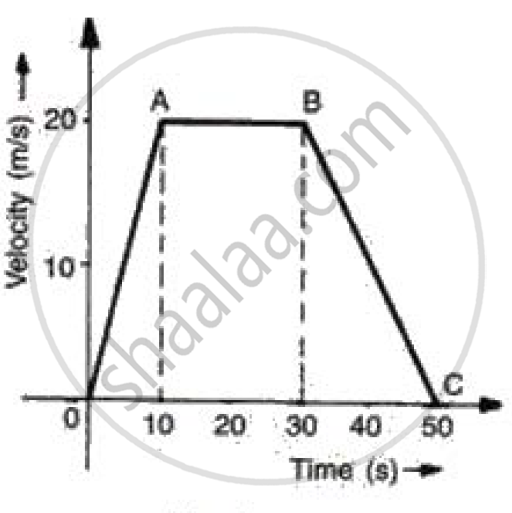
A body moves is a circle of radius ‘2R’ what is the distance covered and displacement of the body after 2 complete rounds?
An object is dropped from rest at a height of 150 m and simultaneously another object is dropped from rest at a height of 100 m. What is the difference in their heights after 2s if both the objects drop with the same accelerations? How does the difference in heights vary with time?
Obtain a relation for the distance travelled by an object moving with uniform acceleration in the interval between 4th and 5th seconds.
The rate of change of displacement ______.
