Advertisements
Advertisements
प्रश्न
A motor car slows down from 72 kmh−1 to 36 kmh−1 over a distance of 25 m. If the brakes are applied with the same force
calculate
- total time in which car comes to rest
- distance travelled by it.
Advertisements
उत्तर

Take motion of a car from A to B:
u = 72 kmh−1 = `72xx5/18` ms−1
u = 20 ms−1
v = 36 kmh−1 = `36xx5/18` ms−1
v = 10 ms−1
(Time) t1 = ?
Acceleration = a = ?
Distance = S1 = 25 m
v2 − u2 = 2aS1
(10)2 − (20)2 = 2a (25)
50a = 100 − 400 = −300
a = `-300/50` = −6 ms−2
Now, v = u + at1
10 = 20 + (−6) t1
6t1 = 20 − 10 = 10
t1 = `10/6` = 1.67s
Take motion of a car from B to C:
u = 36 kmh−1 = 10 ms−1
v = 0
a = −6 ms−2
(Time) t2 = ?
(Distance) S2 = ?
v = u + at2
0 = 10 + (−6) t2
6t2 = 10
t2 = `10/6` = 1.67S
Now, v2 − u2 = 2aS2
(0)2 − (10)2 = 2 (−6) S2
−12S2 = −100
S2 = `100/12` = 8.33 m
Total time taken by car from A to C = t1 + t2 = `10/6+10/6`
= `(10+10)/6=20/6` = 3.33s
Total distance covered by car from A to C = S1 + S2
= 25 + 8.33 = 33.33 m
APPEARS IN
संबंधित प्रश्न
Is displacement a scalar quantity?
What can you say about the nature of motion of a body if its displacement-time graph is A straight line inclined to the time axis with an obtuse angle?
How is the distance related with time for motion under uniform acceleration such as the motion of a freely falling body?
Figure given below shows a velocity-time graph for a car starting from rest. The graph has three parts AB, BC and CD.
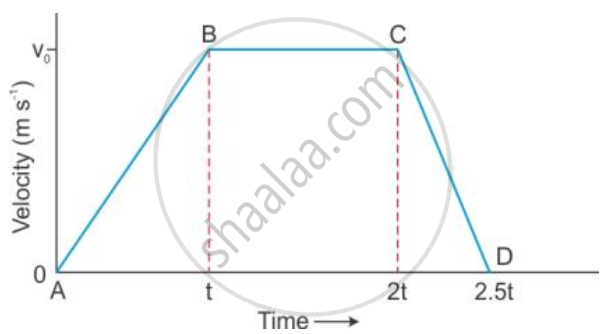
Compare the distance travelled in part BC with the distance travelled in part AB.
A body starts with an initial velocity of 10m s-1 and acceleration 5 m s-2. Find the distance covered by it in 5 s.
When brakes are applied to a bus, retardation produced is 25 cm s-2 and the bus takes 20 s to stop. Calculate -
- The initial velocity of the bus
- The distance travelled by bus during this time.
Calculate the distance and displacement in the following case: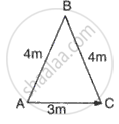
Calculate the distance and displacement in the following case: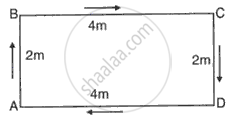
Distance travelled by a freely falling body is proportional to ______.
If the displacement-time graph of a particle is parallel to the time axis, the velocity of the particle is ______.
