Advertisements
Advertisements
प्रश्न
A packet is dropped from a stationary helicopter, hovering at a height ‘h’ from ground level, reaches the ground in 12s. Calculate
- the value of h
- final velocity of packet on reaching the ground. (Take g = 9.8 ms−2)
Advertisements
उत्तर
Height of the helicopter = h =?
Initial velocity = u = 0
Time = t = 12s
Acceleration = a = + g = + 9.8 ms−2
(1) S = ut + `1/2` at2
h = `0(12)+1/2(9.8)(12)^2`
h = 0 + 4.9 (144)
h = 705.6 m
(2) Let v = velocity of the packet on reaching the ground.
v = u + at
v = 0 + (9.8) 12
v = 117.6 ms−1
APPEARS IN
संबंधित प्रश्न
Describe the motion of a body which is accelerating at a constant rate of 10 m s–2. If the body starts from rest, how much distance will it cover in 2 s ?
A train travelling at 20 m s-1 accelerates at 0.5 m s-2 for 30 s. How far will it travel in this time ?
Explain the meaning of the following equation of motion :v = u + at, where symbols have their usual meanings.
A car is travelling along the road at 8 ms-1. It accelerates at 1 ms-2 for a distance of 18 m. How fast is it then travelling ?
Give one example of following motion :
Variable acceleration
A car starting from rest acquires a velocity 180m s-1 in 0.05 h. Find the acceleration.
How can you find the following?
Acceleration from velocity – time graph.
Can you suggest a real-life example about the motion of a body from the following velocity – time graph?
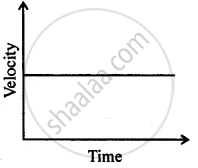
Draw a velocity versus time graph of a stone thrown vertically upwards and then coming downwards after attaining the maximum height.
An electron moving with a velocity of 5 × 10⁴ ms−1 enters into a uniform electric field and acquires a uniform acceleration of 104 ms–2 in the direction of its initial motion.
(i) Calculate the time in which the electron would acquire a velocity double of its initial velocity.
(ii) How much distance the electron would cover at this time?
