Advertisements
Advertisements
प्रश्न
A train starting from a railway station and moving with uniform acceleration attains a speed 40 km h−1 in 10 minutes. Find its acceleration.
Advertisements
उत्तर
Here, initial speed, u = 0
Final speed, v = 40 km h-1
= `(40 xx 1000)/(60 xx 60)`
= 11.11 ms-1
Time taken, t = 10 × 60s
= 600s
Acceleration,
a = `(v - u)/t`
= `(11.11-0)/600`
= 1.85 × 10⁻² ms-2
APPEARS IN
संबंधित प्रश्न
What term is used to denote the change of velocity with time ?
A motorcycle moving with a speed of 5 m/s is subjected to an acceleration of 0.2 m/s2. Calculate the speed of the motorcycle after 10 seconds, and the distance travelled in this time.
A train starting from stationary position and moving with uniform acceleration attains a speed of 36 km per hour in 10 minutes. Find its acceleration.
A freely falling object travels 4.9 m in 1st second, 14.7 m in 2 nd second, 24.5 m in 3rd second, and so on. This data shows that the motion of a freely falling object is a case of :
Can you suggest a real-life example about the motion of a body from the following velocity – time graph?
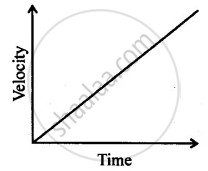
Can you suggest a real-life example about the motion of a body from the following velocity – time graph?
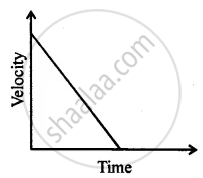
Can you suggest a real-life example about the motion of a body from the following velocity – time graph?
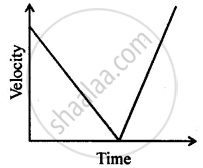
A packet is dropped from a stationary helicopter, hovering at a height ‘h’ from ground level, reaches the ground in 12s. Calculate
- the value of h
- final velocity of packet on reaching the ground. (Take g = 9.8 ms−2)
How will the equations of motion for an object moving with a uniform velocity change?
An object starting from rest travels 20 m in the first 2 s and 160 m in the next 4 s. What will be the velocity after 7 s from the start?
