Advertisements
Advertisements
प्रश्न
When will you say a body is at non-uniform acceleration?
Advertisements
उत्तर
- A body is said to have non-uniform acceleration if it travels in a straight path in such a way that its velocity changes at a non-uniform rate.
- i.e., the velocity of a body increases or decreases in unequal amounts in an equal interval of time.
संबंधित प्रश्न
Give one example of a situation in which a body has a certain average speed but its average velocity is zero.
Fill in the following blank with suitable word :
A motorcycle has a steady……………. of 3 m/s2. This means that every………………. its…………….. increases by………….
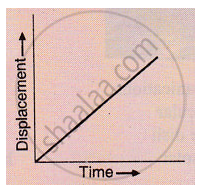
What conclusion can you draw about the velocity of a body from the displacement-time graph shown below :
A motorcycle moving with a speed of 5 m/s is subjected to an acceleration of 0.2 m/s2. Calculate the speed of the motorcycle after 10 seconds, and the distance travelled in this time.
Derive the formula s= `ut+1/2at^2` , where the symbols have usual meanings.
A car is travelling along the road at 8 ms-1. It accelerates at 1 ms-2 for a distance of 18 m. How fast is it then travelling ?
For a uniformly retarded motion, the velocity-time graph is _____________
When is the positive acceleration?
Draw a velocity versus time graph of a stone thrown vertically upwards and then coming downwards after attaining the maximum height.
An object starting from rest travels 20 m in the first 2 s and 160 m in the next 4 s. What will be the velocity after 7 s from the start?
