Advertisements
Advertisements
प्रश्न
A motorcycle moving with a speed of 5 m/s is subjected to an acceleration of 0.2 m/s2. Calculate the speed of the motorcycle after 10 seconds, and the distance travelled in this time.
Advertisements
उत्तर
We have to find the distance travelled and final velocity of the body. We have the following information given,
Initial velocity, (u) = 5 m/s
Acceleration, (a) = 0.2 m/s2
Time taken, (t) = 10 s
So, we can find the final velocity using the relation,
v = u + at
So, final velocity,
v = 5 + (0.2)(10)
= 7 m/s
We can calculate the distance travelled by using the 2nd equation of motion,
`s = ut + 1/2 at^2`
Put the values in above equation to find the distance travelled by the motorcycle ,
`(s) = 5(10) + 1/2(0.2)(10)^2`
= (50 + 10) m
= 60 m
APPEARS IN
संबंधित प्रश्न
A train starting from a railway station and moving with uniform acceleration attains a speed 40 km h−1 in 10 minutes. Find its acceleration.
Name the physical quantity whose SI unit is :
(a) m/s (b) m/s2
Fill in the following blank with suitable word :
If a body moves with uniform velocity, its acceleration is ..............
Which of the following could not be a unit of acceleration?
Differentiate between uniform acceleration and variable acceleration.
A body starts from rest and acquires a velocity 10 m s-1 in 2 s. Find the acceleration.
A bicycle initially moving with a velocity 5.0 m s-1 accelerates for 5 s at a rate of 2 m s-2. What will be its final velocity?
For a uniformly retarded motion, the velocity-time graph is _____________
Multiple choice Question. Select the correct option.
At the maximum height, a body thrown vertically upwards has :
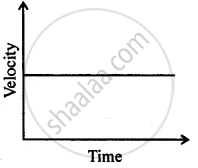
Can you suggest a real-life example about the motion of a body from the following velocity – time graph?