Advertisements
Advertisements
प्रश्न
A bus running at a speed of 18 km/h is stopped in 2.5 seconds by applying brakes. Calculate the retardation produced.
Advertisements
उत्तर
We have to find the value of retardation. So,
Initial velocity,
`(u)` = 18 km/hr
= `"18(1000)"/3600` m/s
= 5 m/s
Final velocity, (v) = 0 m/s
Acceleration , `a = (v-u)/t`
Put the values in the above equation to get the value of acceleration
`a = (0-5)/2.5`
= `-2 "m/s"^2`
Thus, the retardation is 2 m/s2.
APPEARS IN
संबंधित प्रश्न
Give one example of a situation in which a body has a certain average speed but its average velocity is zero.
Fill in the following blank with suitable word :
A motorcycle has a steady……………. of 3 m/s2. This means that every………………. its…………….. increases by………….
Fill in the following blank with a suitable word:
Acceleration is the rate of change of ______ It is measured in ______
A bus was moving with a speed of 54 km/h. On applying brakes it stopped in 8 seconds. Calculate the acceleration.
A car is travelling along the road at 8 ms-1. It accelerates at 1 ms-2 for a distance of 18 m. How fast is it then travelling ?
The velocity-time graph of a body in motion is a straight line inclined to the time axis. The correct statement is ___________
Can you suggest a real-life example about the motion of a body from the following velocity – time graph?
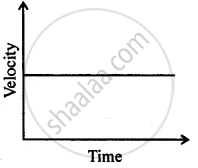
Can you suggest a real-life example about the motion of a body from the following velocity – time graph?
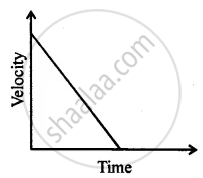
A packet is dropped from a stationary helicopter, hovering at a height ‘h’ from ground level, reaches the ground in 12s. Calculate
- the value of h
- final velocity of packet on reaching the ground. (Take g = 9.8 ms−2)
Draw a velocity versus time graph of a stone thrown vertically upwards and then coming downwards after attaining the maximum height.
