Advertisements
Advertisements
Question
A bus running at a speed of 18 km/h is stopped in 2.5 seconds by applying brakes. Calculate the retardation produced.
Advertisements
Solution
We have to find the value of retardation. So,
Initial velocity,
`(u)` = 18 km/hr
= `"18(1000)"/3600` m/s
= 5 m/s
Final velocity, (v) = 0 m/s
Acceleration , `a = (v-u)/t`
Put the values in the above equation to get the value of acceleration
`a = (0-5)/2.5`
= `-2 "m/s"^2`
Thus, the retardation is 2 m/s2.
APPEARS IN
RELATED QUESTIONS
When will you say a body is at non-uniform acceleration?
Which of the two can be zero under certain conditions : average speed of a moving body or average velocity of a moving body ?
Name the physical quantity whose SI unit is :
(a) m/s (b) m/s2
Fill in the following blank with a suitable word:
Acceleration is the rate of change of ______ It is measured in ______
What is meant by the term acceleration ? State the SI unit of acceleration.
A bus was moving with a speed of 54 km/h. On applying brakes it stopped in 8 seconds. Calculate the acceleration.
When a car driver travelling at a speed of 10 m/s applies brakes and brings the car to rest in 20 s, then retardation will be :
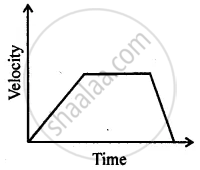
Can you suggest a real-life example about the motion of a body from the following velocity – time graph?
Draw a velocity versus time graph of a stone thrown vertically upwards and then coming downwards after attaining the maximum height.
An object starting from rest travels 20 m in the first 2 s and 160 m in the next 4 s. What will be the velocity after 7 s from the start?
