Advertisements
Advertisements
प्रश्न
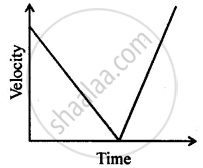
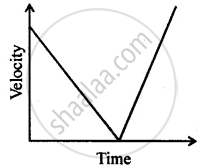
Can you suggest a real-life example about the motion of a body from the following velocity – time graph?
Advertisements
उत्तर
A ball is thrown vertically upward and it returns back to earth after some time. In this situation, the graph will the same as that shown in the figure.
APPEARS IN
संबंधित प्रश्न
A bus decreases its speed from 80 km h−1 to 60 km h−1 in 5 s. Find the acceleration of the bus.
Give one example of a situation in which a body has a certain average speed but its average velocity is zero.
Fill in the following blank with suitable word :
A motorcycle has a steady……………. of 3 m/s2. This means that every………………. its…………….. increases by………….
Fill in the following blank with suitable word :
Velocity is the rate of change of……………………… It is measured in.............. .
Fill in the following blank with suitable word :
If a body moves with uniform velocity, its acceleration is ..............
A freely falling object travels 4.9 m in 1st second, 14.7 m in 2 nd second, 24.5 m in 3rd second, and so on. This data shows that the motion of a freely falling object is a case of :
Define velocity. State its unit.
When is the positive acceleration?
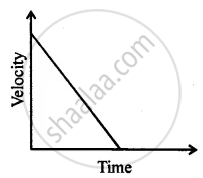
Can you suggest a real-life example about the motion of a body from the following velocity – time graph?
An object starting from rest travels 20 m in the first 2 s and 160 m in the next 4 s. What will be the velocity after 7 s from the start?
