Advertisements
Advertisements
प्रश्न
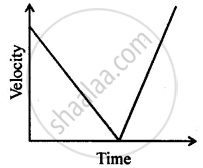
Can you suggest a real-life example about the motion of a body from the following velocity – time graph?
Advertisements
उत्तर
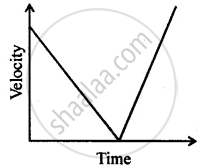
A ball is thrown vertically upward and it returns back to earth after some time. In this situation, the graph will the same as that shown in the figure.
APPEARS IN
संबंधित प्रश्न
When will you say a body is at non-uniform acceleration?
A train starting from a railway station and moving with uniform acceleration attains a speed 40 km h−1 in 10 minutes. Find its acceleration.
Define velocity. What is the SI unit of velocity ?
A cheetah starts from, rest, and accelerates at 2 m/s2 for 10 seconds. Calculate :
(a) the final velocity
(b) the distance travelled.
Derive the formula s= `ut+1/2at^2` , where the symbols have usual meanings.
Define velocity. State its unit.
A body starts from rest and acquires a velocity 10 m s-1 in 2 s. Find the acceleration.
The velocity-time graph (Fig. 8.5) shows the motion of a cyclist. Find (i) its acceleration (ii) its velocity and (iii) the distance covered by the cyclist in 15 seconds.

Draw a velocity versus time graph of a stone thrown vertically upwards and then coming downwards after attaining the maximum height.
Two stones are thrown vertically upwards simultaneously with their initial velocities u1 and u2 respectively. Prove that the heights reached by them would be in the ratio of `"u"_1^2 : "u"_2^2` (Assume upward acceleration is –g and downward acceleration to be +g)
