Advertisements
Advertisements
Question
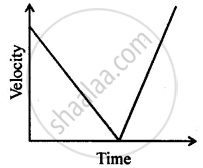
Can you suggest a real-life example about the motion of a body from the following velocity – time graph?
Advertisements
Solution
A ball is thrown vertically upward and it returns back to earth after some time. In this situation, the graph will the same as that shown in the figure.
APPEARS IN
RELATED QUESTIONS
A train starting from a railway station and moving with uniform acceleration attains a speed 40 km h−1 in 10 minutes. Find its acceleration.
What is meant by the term acceleration ? State the SI unit of acceleration.
Explain why, the motion of a body which is moving with constant speed in a circular path is said to be accelerated.
Describe the motion of a body which is accelerating at a constant rate of 10 m s–2. If the body starts from rest, how much distance will it cover in 2 s ?
A bus increases its speed from 36 km/h to 72 km/h in 10 seconds. Its acceleration is :
Can you suggest a real-life example about the motion of a body from the following velocity – time graph?
A packet is dropped from a stationary helicopter, hovering at a height ‘h’ from ground level, reaches the ground in 12s. Calculate
- the value of h
- final velocity of packet on reaching the ground. (Take g = 9.8 ms−2)
A stone thrown vertically upwards takes 3 s to attain maximum height. Calculate
- initial velocity of the stone
- maximum height attained by the stone. (Take g = 9.8 ms−2)
How will the equations of motion for an object moving with a uniform velocity change?
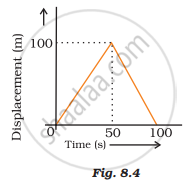
A girl walks along a straight path to drop a letter in the letterbox and comes back to her initial position. Her displacement–time graph is shown in Fig.8.4. Plot a velocity-time graph for the same.