Advertisements
Advertisements
Question
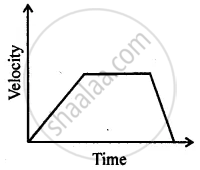
Can you suggest a real-life example about the motion of a body from the following velocity – time graph?
Advertisements
Solution
Suppose a train starts from rest and accelerates uniformly for some time and then moves with a constant velocity for a certain time interval. Then on applying the brakes, the train is uniformly retarded and comes to rest after some time in this situation, velocity – time graph of the train will be the same as shown in the figure.

APPEARS IN
RELATED QUESTIONS
When will you say a body is at non-uniform acceleration?
Fill in the following blank with suitable word :
A motorcycle has a steady……………. of 3 m/s2. This means that every………………. its…………….. increases by………….
Describe the motion of a body which is accelerating at a constant rate of 10 m s–2. If the body starts from rest, how much distance will it cover in 2 s ?
A bus running at a speed of 18 km/h is stopped in 2.5 seconds by applying brakes. Calculate the retardation produced.
Explain the meaning of the following equation of motion :v = u + at, where symbols have their usual meanings.
A train starting from stationary position and moving with uniform acceleration attains a speed of 36 km per hour in 10 minutes. Find its acceleration.
Which of the following could not be a unit of acceleration?
Define velocity. State its unit.
Write three equations of uniformly accelerated motion relating the initial velocity (u), final velocity (v), time (t), acceleration (a) and displacement (S).
Derive the following equations for uniformly accelerated motion:
(i) v = u + at
(ii) `"S = ut" + 1/2 "at"^2`
(iii) v2 = u2 + 2aS
where the symbols have their usual meanings.
