Advertisements
Advertisements
प्रश्न
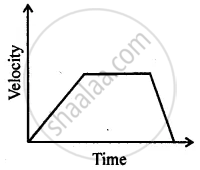
Can you suggest a real-life example about the motion of a body from the following velocity – time graph?
Advertisements
उत्तर
Suppose a train starts from rest and accelerates uniformly for some time and then moves with a constant velocity for a certain time interval. Then on applying the brakes, the train is uniformly retarded and comes to rest after some time in this situation, velocity – time graph of the train will be the same as shown in the figure.

APPEARS IN
संबंधित प्रश्न
A bus decreases its speed from 80 km h−1 to 60 km h−1 in 5 s. Find the acceleration of the bus.
Describe the motion of a body which is accelerating at a constant rate of 10 m s–2. If the body starts from rest, how much distance will it cover in 2 s ?
A motorcycle moving with a speed of 5 m/s is subjected to an acceleration of 0.2 m/s2. Calculate the speed of the motorcycle after 10 seconds, and the distance travelled in this time.
A bus running at a speed of 18 km/h is stopped in 2.5 seconds by applying brakes. Calculate the retardation produced.
A body starting from rest travels with uniform acceleration. If it travels 100 m in 5 s, what is the value of acceleration ?
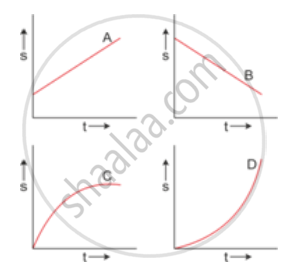
The figure shows the displacement - time graph for four bodies A, B C and D. In each case state what information do you get about the acceleration (zero, positive or negative).
The velocity-time graph of a body in motion is a straight line inclined to the time axis. The correct statement is ___________
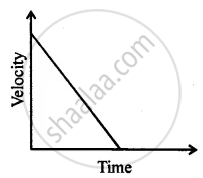
Can you suggest a real-life example about the motion of a body from the following velocity – time graph?
The velocity-time graph (Fig. 8.5) shows the motion of a cyclist. Find (i) its acceleration (ii) its velocity and (iii) the distance covered by the cyclist in 15 seconds.

An object starting from rest travels 20 m in the first 2 s and 160 m in the next 4 s. What will be the velocity after 7 s from the start?
