Advertisements
Advertisements
Question
A bus increases its speed from 36 km/h to 72 km/h in 10 seconds. Its acceleration is :
Options
5 m/s2
2 m/s2
3.6 m/s2
1 m/s2
Advertisements
Solution
1 m/s2
Final velocity is = 72 km/h = 20 m/s
Initial velocity is = 36 km/h = 10 m/s
Time taken is 10 sec. so,
Acceleration = `(20-10)/10`
= 1 m/s2
So, the answer is
(d) 1 m/s2
APPEARS IN
RELATED QUESTIONS
Name the physical quantity whose SI unit is :
(a) m/s (b) m/s2
Fill in the following blank with suitable word :
Velocity is the rate of change of……………………… It is measured in.............. .
Name the quantity which is measured by the area occupied under the velocity-time graph.
A train starting from stationary position and moving with uniform acceleration attains a speed of 36 km per hour in 10 minutes. Find its acceleration.
A freely falling object travels 4.9 m in 1st second, 14.7 m in 2 nd second, 24.5 m in 3rd second, and so on. This data shows that the motion of a freely falling object is a case of :
The slope of a speed-time graph gives:
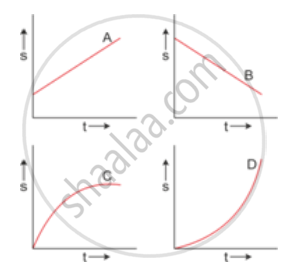
The figure shows the displacement - time graph for four bodies A, B C and D. In each case state what information do you get about the acceleration (zero, positive or negative).
What do you understand by the term acceleration?
Area under a v – t graph represents a physical quantity which has the unit
An electron moving with a velocity of 5 × 10⁴ ms−1 enters into a uniform electric field and acquires a uniform acceleration of 104 ms–2 in the direction of its initial motion.
(i) Calculate the time in which the electron would acquire a velocity double of its initial velocity.
(ii) How much distance the electron would cover at this time?
