Advertisements
Advertisements
Question
Derive the following equation of motion by the graphical method : v2 = u2 + 2as, where the symbols have their usual meanings.
Advertisements
Solution
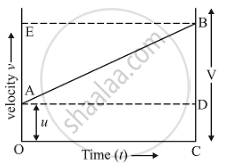
In the given figure, the distance travelled (s) by a body in time (t) is given by the area of the figure OABC which is a trapezium.
Distance travelld = Area of the trapezium OABC
So, Area of trapezium OABC,
= `"(Sum of parallel sides)(Height)"/2`
=`"(OA+CB)(OC)"/2`
Now, (OA + CB) = u + v and (OC) = t.
Putting these values in the above relation, we get:
`s = ((u+v)/2)t` ....(1)
Eliminate t from the above equation. This can be done by obtaining the value of t from the first equation of motion.
v = u + at
So,
`t = "v-u"/a`
Now, put this value of t in equation (1), we get:
`s = (((u+v)(v-u))/(2a))`
On further simplification,
2as = v2 – u2
Finally the third equation of motion.
`v^2 = u^2 + 2as`
where
(s) - Displacement
(u) - Initial velocity
(a) - Acceleration
(v) - Final velocity
(t) - Time taken
APPEARS IN
RELATED QUESTIONS
Three speed-time graphs are given below :
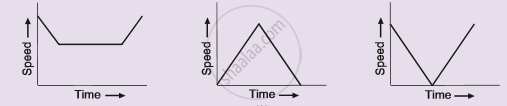
Which graph represents the case of:
(i) a cricket ball thrown vertically upwards and returning to the hands of the thrower ?
(ii) a trolley decelerating to a constant speed and then accelerating uniformly ?
From the velocity – time graph given below, calculate acceleration in the region AB.
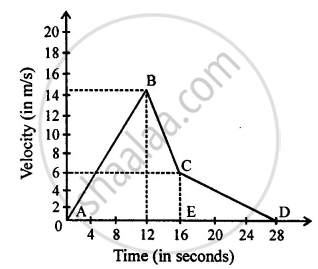
From the velocity – time graph given below, calculate Average velocity in region CED.
The area under a speed-time graph in a given intervals gives the total distance covered by a body irrespective of its motion being uniform or non-uniform.
The area of the right triangle under a speed-time graph is 500 m, in a time interval of 20 s. What is the speed of the body? Is the motion uniform or non-uniform?
Interpret the following graph: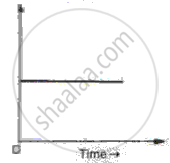
Interpret the following graph: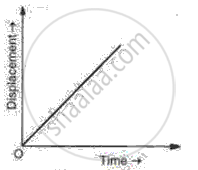
Which of the following graphs represents a motion with negative acceleration?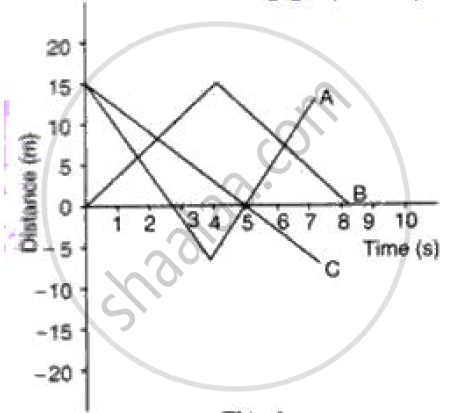
Draw velocity-time graph to show:
Deceleration
Write a sentence to explain the shape of graph.
The velocity-displacement graph describing the motion of a bicycle is shown in the figure.

The acceleration-displacement graph of the bicycle's motion is best described by:
