Advertisements
Advertisements
Question
Show by using the graphical method that: `s=ut+1/2at^2` where the symbols have their usual meanings.
Advertisements
Solution
Suppose the body travels a distance (s) in time (t).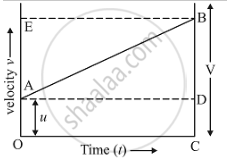
In the figure, the distance travelled by the body is given by the area of the space between the velocity-time graph AB and the time axis OC, which is equal to the area of the figure OABC.
Thus: Distance travelled = Area of the trapezium OABC
But, Area of the figure OABC = Area of rectangle OADC + Area of triangle ABD
= Area of rectangle OADC + area of triangle ABD
Now, find out the area of rectangle OADC and area of triangle ABD.
(i) Area of rectangle OADC
= (OA) (OC)
= (u) (t)
(ii) Area of triangle ABD,
= (1/2)(AD)(BD)
= (1/2)(t)(at)
= (1/2)at2
Distance travelled (s) is,
So, s = Area of rectangle OADC + Area of triangle ABD
`s = ut + 1/2at^2`
This is the second equation of motion.
Where
(s) - Displacement
(u) - Initial velocity
(a) - Acceleration
(t) - Time
APPEARS IN
RELATED QUESTIONS
What conclusion can you draw about the acceleration of a body from the speed-time graph shown below .
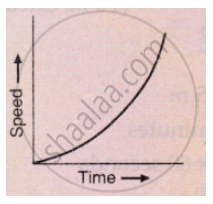
Name the two quantities, the slope of whose graph give acceleration.
What type of motion is represented by the following graph ?
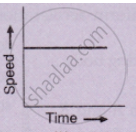
A car of mass 1000 kg is moving with a velocity of 10 m s−1. If the velocity-time graph for this car is a horizontal line parallel to the time axis, then the velocity of car at the end of 25 s will be :
Draw the following graph:
Speed versus time for a fluctuating speed.
Its time-displacement graph is a straight line.
What can you say about the motion of a body if:
Its time-velocity graph is a straight line
What does the slope of velocity-time graph represent?
Figure shows the distance-time graph of three students A, B and C. On the basis of the graph, answer the following :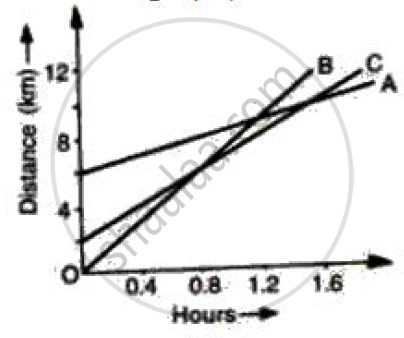
Will the three ever meet at any point on the road?
Saphira moves at a constant speed in the same direction. Rephrase the same sentence in fewer words using concepts related to motion.
