Advertisements
Advertisements
Question
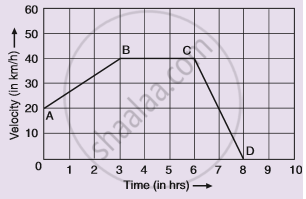
Given alongside is the velocity-time graph for a moving body :
Find :
(i) Velocity of the body at point C.
(ii) Acceleration acting on the body between A and B.
(iii) Acceleration acting on the body between B and C.
Advertisements
Solution
(i) BC represents uniform velocity. So velocity of the body at point C is 40 km
(ii) Acceleration = Slope of line AB
= `((40-20))/((3-0)) (km)/(hr^2)`
= 6.66 `"km/hr"^2`
(iii) BC represents uniform velocity, so, acceleration acting on the body is zero.
APPEARS IN
RELATED QUESTIONS
Show by using the graphical method that: `s=ut+1/2at^2` where the symbols have their usual meanings.
The speed-time graph of an ascending passenger lift is given alongside. What is the acceleration of the lift:
(1) during the first two seconds ?
(2) between second and tenth second ?
(3) during the last two seconds ?
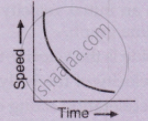
What type of motion is represented by the following graph ?
Multiple choice Question. Select the correct option.
A graph is a straight line parallel to the time axis in a distance-time graph. From the graph, it implies:
Draw displacement – time graph for the following situation:
When a body is stationary.
The graph of one quantity versus another result in a straight line. How are the quantities related to each other?
Draw distance-time graph to show:
Increasing velocity
Interpret the following graph: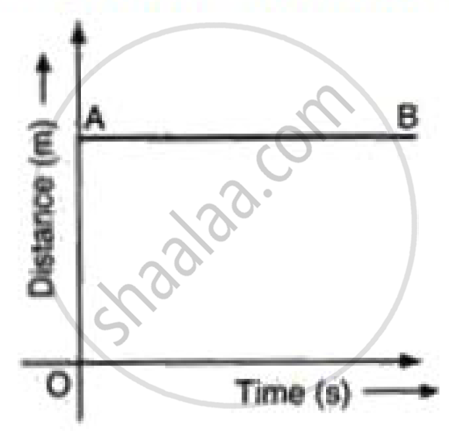
What does the slope of velocity-time graph represent?
The area of the velocity-time graph gives the displacement of the body.
