Advertisements
Advertisements
Question
A body is moving uniformly in a straight line with a velocity of 5 m/s. Find graphically the distance covered by it in 5 seconds.
Advertisements
Solution
We have to calculate the distance travelled by the moving body whose speed time graph is given to us.
Distance travelled = Area of rectangle OABC
So, distance travelled,
= (OA)(OC)
= (5)(5) m
= 25 m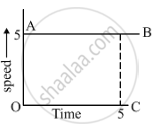
APPEARS IN
RELATED QUESTIONS
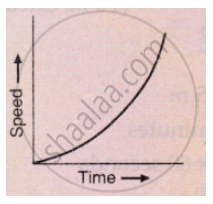
What conclusion can you draw about the acceleration of a body from the speed-time graph shown below .
Fill in the following blank with suitable word :
In a speed-time graph, the area enclosed by the speed-time curve and the time axis gives the…………….. by the body.
The velocity-time graph for part of a train journey is a horizontal straight line. What does this tell you about the trains velocity.
Diagram shows a velocity – time graph for a car starting from rest. The graph has three sections AB, BC and CD.
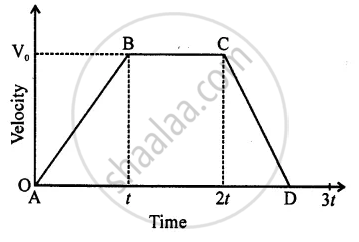
Compare the distance travelled in section BC with the distance travelled in section AB.
From the velocity – time graph given below, calculate Average velocity in region CED.
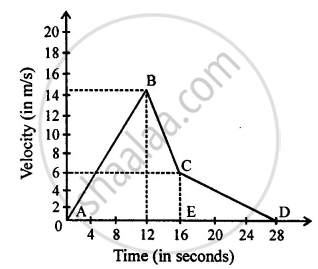
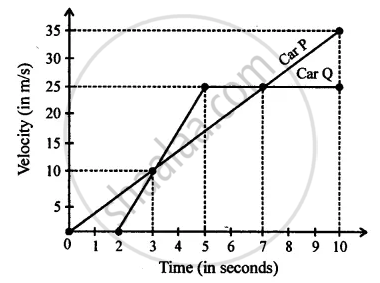
Diagram is given below shows velocity – time graph of car P and Q, starting from the same place and in the same direction. Calculate which car is ahead after 10 s and by how much?
Represent the position of a body described as at 15 m, 30o north of west, on a graph paper.
The area of the right triangle under a speed-time graph is 500 m, in a time interval of 20 s. What is the speed of the body? Is the motion uniform or non-uniform?
The graph of one quantity versus another result in a straight line. How are the quantities related to each other?
Figure shows the distance-time graph of three students A, B and C. On the basis of the graph, answer the following :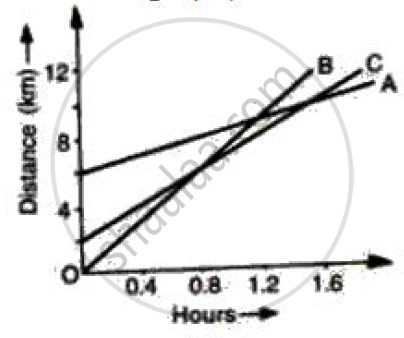
When B meets A, where is C?
