Advertisements
Advertisements
प्रश्न
A body is moving uniformly in a straight line with a velocity of 5 m/s. Find graphically the distance covered by it in 5 seconds.
Advertisements
उत्तर
We have to calculate the distance travelled by the moving body whose speed time graph is given to us.
Distance travelled = Area of rectangle OABC
So, distance travelled,
= (OA)(OC)
= (5)(5) m
= 25 m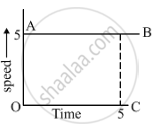
APPEARS IN
संबंधित प्रश्न
What can you say about the motion of a body if:
its velocity-time graph is a straight line ?
Study the speed-time graph of a car given alongside and answer the following questions:
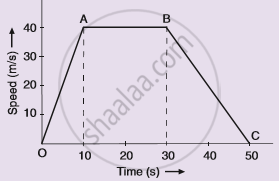
(i) What type of motion is represented by OA ?
(ii) What type of motion is represented by AB ?
(iii) What type of motion is represented by BC ?
(iv) What is the acceleration of car from O to A ?
(v)What is the acceleration of car from A to B ?
(vi) What is the retardation of car from B to C ?
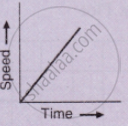
What type of motion is represented by the following graph ?
Represent the location of an object described as at 15 m, 45o west of north, on a graph paper.
Draw the speed-time graph of a body starting from some point P, gradually picking up speed, then running at a uniform speed and finally slowing down to stop at some point Q.
What can you conclude if the speed-time graph of a body is a curve moving upwards starting from the origin?
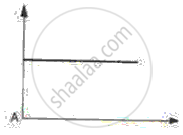
Given below are the speed -time graphs. Match them with their corresponding motions :
 |
(a) Uniformity retared motion |
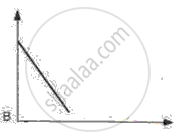 |
(b) Non-uniformity acceleration |
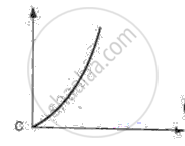 |
(c) Non-uniform motion |
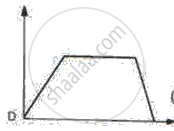 |
(d) uniform motion |
What can you say about the nature of motion of a body of its displacement-time graph is:
A straight line inclined to the time axis with an acute angle?
Draw distance-time graph to show:
Increasing velocity
Figure shows the distance-time graph of three students A, B and C. On the basis of the graph, answer the following :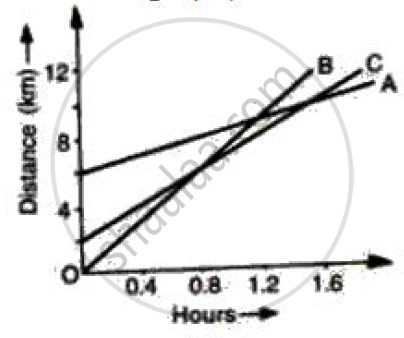
Which of the three is traveling the fastest?
