Advertisements
Advertisements
प्रश्न
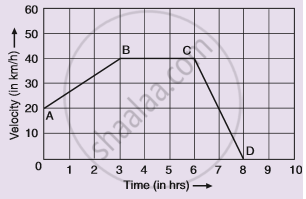
Given alongside is the velocity-time graph for a moving body :
Find :
(i) Velocity of the body at point C.
(ii) Acceleration acting on the body between A and B.
(iii) Acceleration acting on the body between B and C.
Advertisements
उत्तर
(i) BC represents uniform velocity. So velocity of the body at point C is 40 km
(ii) Acceleration = Slope of line AB
= `((40-20))/((3-0)) (km)/(hr^2)`
= 6.66 `"km/hr"^2`
(iii) BC represents uniform velocity, so, acceleration acting on the body is zero.
APPEARS IN
संबंधित प्रश्न
From the displacement-time graph of a cyclist given below in the Figure, find The time after which he reaches the starting point .
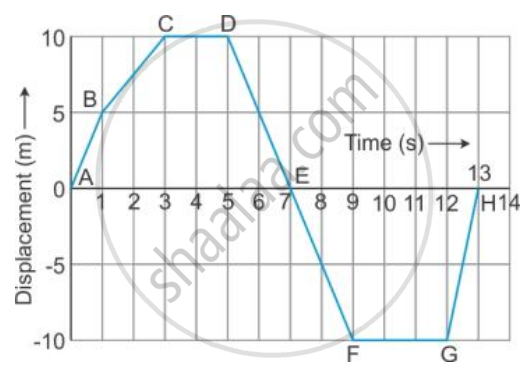
Diagram shows a velocity – time graph for a car starting from rest. The graph has three sections AB, BC and CD.
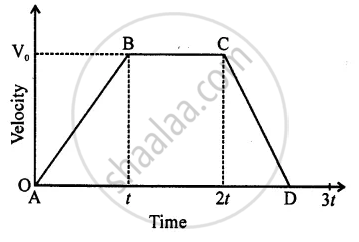
From a study of this graph, state how the distance travelled in any section is determined.
Diagram shows a velocity – time graph for a car starting from rest. The graph has three sections AB, BC, and CD.
In which section, car has a zero acceleration?
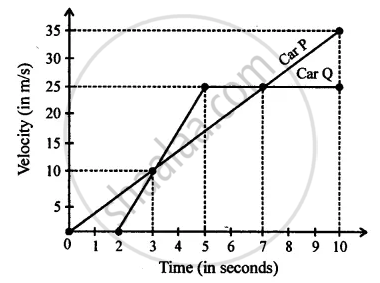
Diagram is given below shows velocity – time graph of car P and Q, starting from the same place and in the same direction. Calculate at what time intervals both cars have the same velocity?
How will you use a speed-time graph to find whether the acceleration of the body is uniform or not?
Draw the speed-time graph of a body starting from some point P, gradually picking up speed, then running at a uniform speed and finally slowing down to stop at some point Q.
Interpret the following graph: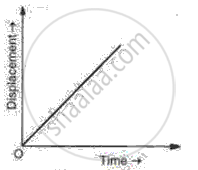
What can you say about the nature of motion of a body of its displacement-time graph is:
A straight line parallel to line axis?
State whether true or false. If false, correct the statement.
If the velocity – time graph of a particle is a straight line inclined to X-axis then its displacement – time graph will be a straight line.
Mention the uses of the velocity-time graph.
