Advertisements
Advertisements
प्रश्न
Interpret the following graph: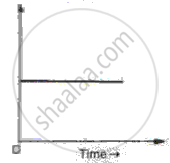
Advertisements
उत्तर
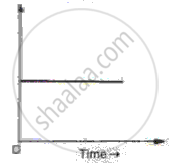
If distance time graph of a body is straight line parallel to x axis then the body is said to be at rest .
APPEARS IN
संबंधित प्रश्न
What is the quantity which is measured by the area occupied below the velocity-time graph?
What can you say about the motion of a body if its speed-time graph is a straight line parallel to the time axis ?
Fill in the following blank with suitable word :
In a speed-time graph, the area enclosed by the speed-time curve and the time axis gives the…………….. by the body.
What can you say about the motion of a body if:
its displacement-time graph is a straight line ?
Define speed. What is its S.I. unit?
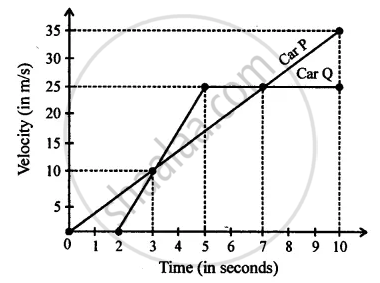
Diagram is given below shows velocity – time graph of car P and Q, starting from the same place and in the same direction. Calculate at what time intervals both cars have the same velocity?
Draw the speed-time graph of a body when its initial speed is not zero and the speed increases uniformly with time.
What can you conclude if the speed-time graph of a body is a straight line sloping upwards and not passing through the origin?
What does the slope of speed-time graph indicate?
The velocity-displacement graph describing the motion of a bicycle is shown in the figure.

The acceleration-displacement graph of the bicycle's motion is best described by:
