Advertisements
Chapters
▶ 2: Motion in One Dimension
3: Laws of Motion
4: Fluids
5: Heat
6: Light
7: Sound
8: Electricity and Magnetism
![Frank solutions for Physics [English] Class 9 ICSE chapter 2 - Motion in One Dimension - Shaalaa.com](/images/physics-english-class-9-icse_6:1a0f7706074c4feda1fb5ca0ff12ac66.jpg "Frank solutions for Physics [English] Class 9 ICSE chapter 2 - Motion in One Dimension")
Advertisements
Solutions for Chapter 2: Motion in One Dimension
Below listed, you can find solutions for Chapter 2 of CISCE Frank for Physics [English] Class 9 ICSE.
Frank solutions for Physics [English] Class 9 ICSE 2 Motion in One Dimension Exercise 1 [Pages 61 - 62]
Define the state of rest.
What do you mean by a vector quantity?
How is a vector represented?
A book is lying in an almirah. Is it at rest or in motion?
What do you mean by motion?
Are rest and motion relative?
Out of force and energy, which one is vector?
Give two examples of scalars.
Different positions of a body are given below. Which of the two positions lie on the same straight line?
(i) 8 m, 60o NE
(ii) 3 m, 60o NE
(iii) 5 m, 60o EN
(iv) 5 m, 60o NW
A quantity can be represented only when its magnitude and direction are specified. Is it scalar or vector?
Are the passengers sitting in a train in motion or at rest with respect to each other?
You are at rest as well as in motion. Justify the statement giving your point of view.
A train is moving out of a railway station. Is the platform at rest or in motion with respect to the moving train? Justify your answer.
Represent the location of an object described as at 15 m, 45o west of north, on a graph paper.
Represent the position of a body described as at 15 m, 30o north of west, on a graph paper.
Name the physical quantity representing the magnitude and its direction.
Answer the following question:
Can we add two scalars?
Answer the following question:
Can we add two vectors?
Answer the following question:
Can we multiply two scalars?
Answer the following question:
Can we add a scalar quantity to a vector quantity?
Answer the following question:
Can we subtract two scalars?
Answer the following question:
Can we subtract a scalar quantity from a vector quantity? Is the reverse true?
Answer the following question:
Can we multiply vectors?
What do you mean by the distance traveled by a body?
Can distance covered by a body be less than the magnitude of its displacement?
Define Displacement.
Define displacement.
Write the SI units for measurement of distance and displacement.
Show the difference between distance and displacement with the help of a diagram.
Can a body have negative displacement?
Under what condition is the displacement of a body equal to the distance traveled by it?
Write two differences between distance and displacement.
Calculate the distance and displacement in the following case: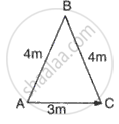
Calculate the distance and displacement in the following case: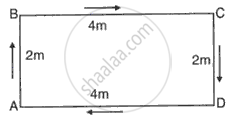
Calculate the distance and displacement in the following case: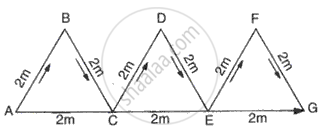
A body is moving along a circular path of radius r. What will be the distance and displacement of the body when it completes:
Half a revolution
A body is moving along a circular path of radius r. What will be the distance and displacement of the body when it completes:
`(3/4)` th of a revolution
A body is moving along a circular path of radius r. What will be the distance and displacement of the body when it completes:
Full revolution
A body is moving along a circular path of radius r. What will be the distance and displacement of the body when it completes:
Two full revolutions
Ashok starts from his house and travels 3 km to reach his school. On finding the school gates closed, he returns to his house. What is?
The distance traveled by Ashok.
Ashok starts from his house and travels 3 km to reach his school. On finding the school gates closed, he returns to his house. What is?
The displacement of Ashok
A satellite makes a complete round along its circular orbit. What is its displacement?
An object is thrown vertically upwards. It rises upto a height H and then returns to its initial position. Calculate
The total distance traveled by the object
An object is thrown vertically upwards. It rises upto a height H and then returns to its initial position. Calculate
The displacement of the object.
Frank solutions for Physics [English] Class 9 ICSE 2 Motion in One Dimension Exercise 2 [Pages 79 - 80]
Define speed of a body.
What do you understand by the average speed of a body?
Write the SI units of speed and average speed.
Do speed and average speed of a body have the same meaning?
Which is greater?
(i) 60 km/hr
(ii) 15 m/s
Convert 20 m/s into km/hr.
Which is greater?
(i) 36 km/hr
(ii) 8.5 m/s
What are the SI units of velocity?
Two cars are moving with speeds of 40 km/hr due North and 40 km/hr due South respectively. Do they have the same velocity?
Arrange the following speeds in the increasing order:
(i) A bicycle moving with a speed of 36 km/h.
(ii) A car moving with a speed of 2 km/min.
(iii) An athlete running with a speed of 7 m/s.
A boy covers half of his journey with a uniform speed of u and the other half with a uniform speed of v. What is the average speed for the whole journey?
Does uniform speed mean constant speed?
A body goes from P to Q with a uniform speed of u and immediately returns back to P at a uniform speed of v. What is the average speed for the whole journey?
A body goes from P to Q with a uniform speed of u and immediately returns back to P at a uniform speed of v. what is the average velocity for the whole journey?
A car travels from P to Q at a uniform speed of 20 ms-1 and immediately turns back and travels towards Q with a uniform speed of 30 ms-1. What is the average speed for the whole journey?
How does speed differ from velocity?
When do the speed and velocity of a moving body become equal?
What is meant by a constant velocity? Is it same as uniform velocity?
Define acceleration.
What is the SI unit of acceleration?
The acceleration of a moving body is constant in magnitude and direction. Must the path of the body be a straight line?
If not, given an example.
The relation S= v x t can easily be used to find the tota l distance covered by a body moving with non -uni form speed. (Yes/ no)
The area under a speed-time graph in a given intervals gives the total distance covered by a body irrespective of its motion being uniform or non-uniform.
The area of the right triangle under a speed-time graph is 500 m, in a time interval of 20 s. What is the speed of the body? Is the motion uniform or non-uniform?
What does a positive acceleration mean?
A body falls towards the earth. Does it have positive or negative acceleration?
The acceleration of a body is 8.5 ms-2. What does this statement mean?
Write the SI unit of retardation.
A car traveling at 60 km/h, stops on applying brakes in 10 seconds. What is its acceleration?
A quantity is measured to be -30 m/s. Is it speed or velocity?
Give the name of the physical quantity that corresponds to the rate of change of displacement.
Can the speed of a body be negative?
What kind of a velocity does a flying bird most likely to have?
(a) Uniform velocity, or
(b) Non- uniform velocity.
Find the initial velocity of a car which is stopped in 10 seconds by applying brakes. Retardation due to brakes is 2.5 ms-2.
What do you understand by the equations of motion?
What do you understand by the equations of motion?
Write down the three equations of motion.
How many variables are present in each equation of motion?
What are the uses of equations of motion?
Write the SI unit of acceleration and retardation.
Name the physical quantity which is equal to the area under speed-time graph.
Distinguish between uniformly and non-uniformly accelerated motions.
Can you use the relation [B1]?
How does the slope of a speed-time graph give the acceleration of a body moving along a straight line?
Give two examples of uniform circular motion from your daily life.
How will you use a speed-time graph to find whether the acceleration of the body is uniform or not?
The graph of one quantity versus another result in a straight line. How are the quantities related to each other?
A car travels at a uniform speed of 42 km/h. In 10 minutes, how much distance would it cover?
The initial velocity of a car is 10 ms-1. It moves with an acceleration of 2 ms-2. What will be its speed after 10 seconds?
The speed of a car increases from 10 km/h to 64 km/h in 10 seconds. What will be its acceleration?
Given on th e side are a few speed - time graphs for various objects moving along a stra ight line. Refer below figure. (a), (b), (c) and (d).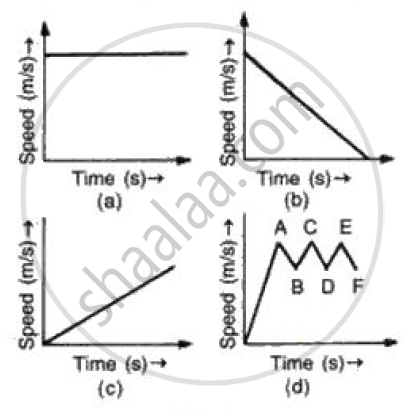
Which of these graphs represent
(a) Uni form motion
(b) Motion with speed increasing
(c) Motion with speed decreasing and
(d) Motion with speed oscillating.?
Can a body have negative speed?
Is distance covered during nth second more than the distance covered in n seconds?
Draw the speed-time graph of a body when its initial speed is not zero and the speed increases uniformly with time.
Draw the speed-time graph of a body starting from some point P, gradually picking up speed, then running at a uniform speed and finally slowing down to stop at some point Q.
What can you conclude if the speed-time graph of a body is a curve moving upwards starting from the origin?
What can you conclude if the speed-time graph of a body is a straight line sloping upwards and not passing through the origin?
Draw the following graph:
Speed versus time for a stepped motion
Draw the following graph:
Speed versus time for a non-uniform acceleration.
Draw the following graph:
Distance versus time for a body at rest.
Draw the following graph:
Speed versus time for a fluctuating speed.
Draw the following graph:
Speed versus time for a uniformly retarded motion.
Interpret the following graph: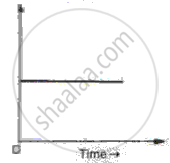
Interpret the following graph: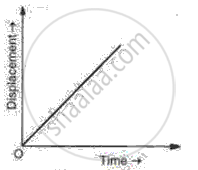
Given below are the speed -time graphs. Match them with their corresponding motions :
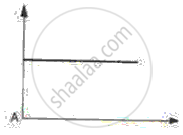 |
(a) Uniformity retared motion |
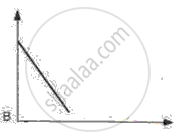 |
(b) Non-uniformity acceleration |
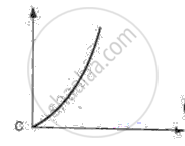 |
(c) Non-uniform motion |
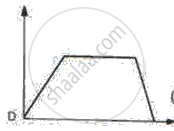 |
(d) uniform motion |
Derive the equations
(i) v= u+at and
(ii) v2-u2= 2as, where the symbols have their usual meanings.
Derive th e equation of motion.
S = ut+ `1/2` at2,
Where the symbols have their usual meanings
Frank solutions for Physics [English] Class 9 ICSE 2 Motion in One Dimension Exercise 3 [Pages 83 - 87]
Write two examples of vectors.
Write the SI unit of retardation.
Name the physical quantity associated with the rate of change of displacement with time.
Define angular velocity
When a body said to have a uniform velocity?
Out of energy and acceleration, which one is a vector?
What does the slope of speed-time graph indicate?
A stone is dropped from a certain height. Is its motion uniform or non-uniform?
The distance covered by a body is directly proportional to the square of the time elapsed. What can you say about its acceleration?
Which of the following graphs represents a motion with negative acceleration?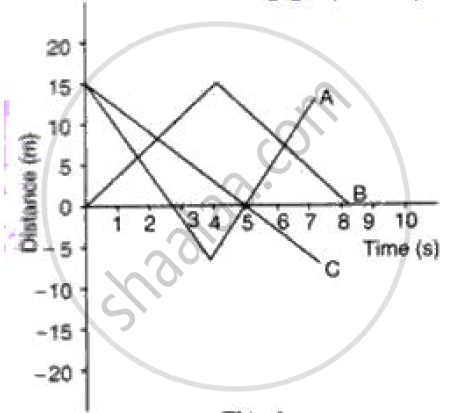
State if the following situation is possible:
A body moving with constant acceleration but with Zero velocity.
State if the following situation is possible:
A body moving horizontally with an acceleration in vertical direction.
State if the following situation is possible:
A body moving with a constant velocity in an accelerated motion.
Figure shows displacement- time graph of two objects A and B moving in a stra ight line. Which object is moving fa ster?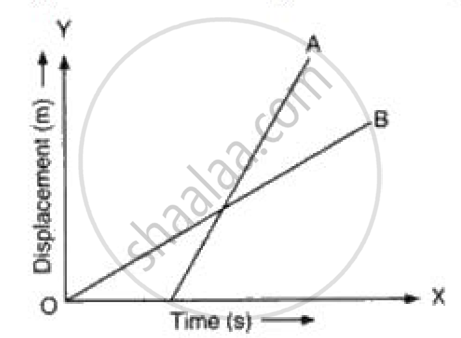
What can you say about the nature of motion of a body of its displacement-time graph is:
A straight line parallel to line axis?
What can you say about the nature of motion of a body of its displacement-time graph is:
A straight line inclined to the time axis with an acute angle?
Is it possible for an accelerating body to have constant speed?
Its time-displacement graph is a straight line.
What can you say about the motion of a body if:
Its time-velocity graph is a straight line
Is the average speed during different time intervals for a uniform motion the same or different?
What is the velocity of a stone thrown vertically upwards at its maximum height?
Why does the velocity of a stone thrown vertically upwards decreases?
What is the relation between linear velocity and linear speed?
Draw distance-time graph to show:
Increasing velocity
Draw distance-time graph to show:
Uniform velocity
Draw distance-time graph to show:
Decreasing velocity
Draw velocity-time graph to show:
Acceleration
Write a sentence to explain the shape of graph.
Draw velocity-time graph to show:
Deceleration
Write a sentence to explain the shape of graph.
Draw velocity-time graph to show:
Zero acceleration
Write a sentence to explain the shape of graph.
Interpret the following graph: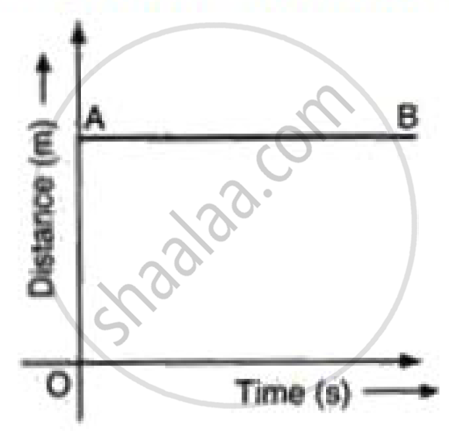
Interpret the following graph: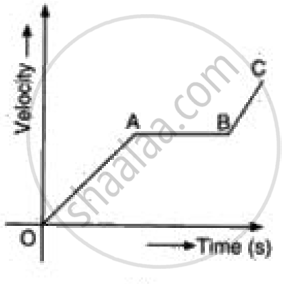
During circular motion, which physical quantity of the body:
Remains constant
During circular motion, which physical quantity of the body:
Changes continuously
Is the following statement correct? If not, modify it suitably to make it correct. "The earth moves round the sun with uniform velocity".
A particle moves along a circular path. How many times does it change its direction in two complete rounds?
A body moves along a circular path of radius r. When it completes three complete rounds, what is the ratio of distance covered to its displacement?
What happens to the stepwise increasing speed-time graph when the size of each step is made very small?
A body has an acceleration of -3.5 ms-2. What is its retardation?
The average time taken by a normal person to react to an emergency is one fifteenth of a second and is called the 'reaction time'. If a bus is moving with a velocity of 60 km/h and its driver sees a child running across the road, how much distance would the bus had moved before he could press the brakes? The reaction time of the people increases when they are intoxicated. How much distance had the bus moved if the reaction time of the driver were 1/2 s under the influence of alcohol?
A girl had designed a clap switch for a science exhibition that enabled her to switch on or off an alarm just with clapping of hands. While testing her device in a hall, she noticed that once the alarm has sounded it followed with another one due to echo of the clap, that is, the sound reflected by the walls. She recorded the two soundings of alarm with her tape recorder and found out that time difference in between them is 0.1 s. If the distance of the walls be 15 m, calculate the speed of sound.
An artificial satellite is moving in a circular orbit of radius nearly 42,250 km. Calculate its linear velocity, if it takes 24 hours to revolve round the earth
A circular cycle track has a circumstance of 314 m with AB as one of its diameter. A cyclist travels from A to B along the circular path with a velocity of constant magnitude 15. 7 m/ s. Find :
(a) The distance moved by the cyclist.
(b) The displacement of the cyclist if AB represents north-south direction .
(c) The average velocity of the cyclist.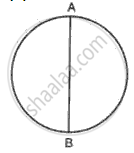
What does the slope of velocity-time graph represent?
What does the slope of velocity-time graph represent?
Figure shows the velocity-time graphs for two objects A and B moving in same direction . Which object has the greater a cceleration?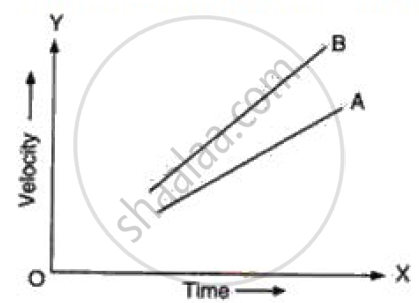
Sketch the shape of the velocity-time graph for a body moving with:
Uniformly velocity
Sketch the shape of the velocity-time graph for a body moving with:
Uniform acceleration.
Derive the equation
S = ut+ `1/2` at2
Using a speed- time graph
Derive the equation
V2-u2 = 2as
For a body moving along a circular path, show that:
Linear speed = Angular velocity X radius of the circle
Draw the distance-time graphs of the bodies P and Q starting from rest, moving with uniform speeds with P moving faster than Q.
A body covers half the distance with the speed A and the other half with speed B. What will be the average speed for the whole journey?
A car travels 30 km at a uniform speed of 60 km/h and the next 30 km at a uniform speed of 20 km/h. What is its average speed?
On a 120 km track, a train travels the first 40 km at a uniform speed of 30 km/h. How fast must the train travel the next 80 km, so as to average 60 km/h for the entire trip.
Figure shows the distance-time graph of three students A, B and C. On the basis of the graph, answer the following :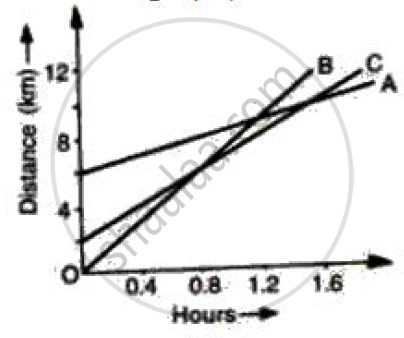
Which of the three is traveling the fastest?
Figure shows the distance-time graph of three students A, B and C. On the basis of the graph, answer the following :
Will the three ever meet at any point on the road?
Figure shows the distance-time graph of three students A, B and C. On the basis of the graph, answer the following :
When B meets A, where is C?
Figure shows the distance-time graph of three students A, B and C. On the basis of the graph, answer the following :
How far did B travel between the time he passed C and A?
In figure the position of a body times is shown . Calculate the speed of the body as it moves from 0 to A, A to B, B to C and i ts average speed .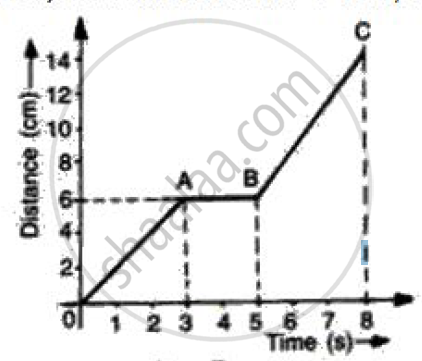
Two friends leave Delhi for Chandigarh in their cars. A starts at 5 am and moves with a constant speed of 30 km/h, whereas B starts at 6 am and moves with a constant speed of 40 kmh-1. Plot the distance-time graph for their motion and find at what time the two friends will meet and at what distance from Delhi.
A car accelerates uniformly from a velocity of 18 km/h to 36 km/h in 15 min. What is its acceleration?
A car is moving with a speed of 50 km/h. One second later, its speed is 55 km/h. What is its acceleration?
Convert the following acceleration:
7200 km/h2 into m/s2
Convert the following acceleration:
1/36 m/s2 into km/h2
A body moves along a straight road with a speed of 20 m/s and has a uniform acceleration of 5 m/s2. What will be its speed after 2 s?
A car moving with a uniform acceleration of 10 m/s2 on a straight road changes its speed from 10 m/s to 30 m/s. Find the time lapsed for the change of speed.
The graph shows how the velocity of a scooter varies with time in 50 s. Interpret the graph.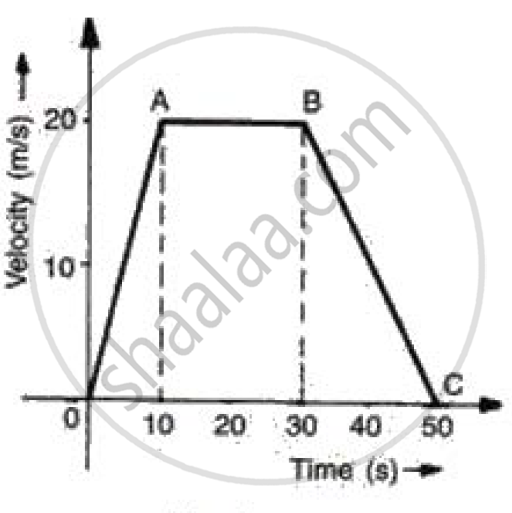
The graph shows how the velocity of a scooter varies with time in 50 s.
Work out: Acceleration.
The graph shows how the velocity of a scooter varies with time in 50 s.
Work out: The distance traveled in 10 s, 20 s, and 50 s.
The graph shows how the velocity of a scooter varies with time in 50 s.
Work out: Deceleration
A car accelerates to a velocity of 30 m/s in 10 s and then decelerates for 20 s so that it stops. Draw a velocity-time graph to represent the motion and find:
The acceleration.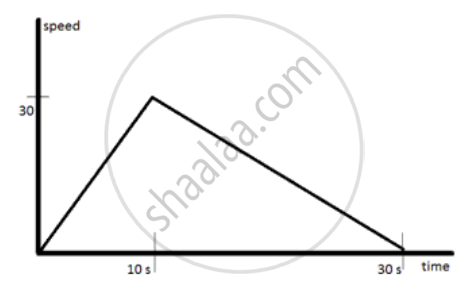
A car accelerates to a velocity of 30 m/s in 10 s and then decelerates for 20 s so that it stops. Draw a velocity-time graph to represent the motion and find:
The Deceleration.
A car accelerates to a velocity of 30 m/s in 10 s and then decelerates for 20 s so that it stops. Draw a velocity-time graph to represent the motion and find:
Distance travelled
A body moves along a straight track. Half of the distance it covers with a velocity of 40 ms-1 and the remaining half with a velocity of 60 ms-1. What is the average velocity for the whole journey?
A body goes from A to B with a velocity of 30 ms-1 and comes back from B to A with a velocity of 20 ms-1. What is the average velocity of the body for the whole journey?
A body starts to slide over a horizontal surface with an initial velocity of 0.5 ms−1. Due to friction, its velocity decreases at the rate of 0.05 ms−2. How much time will it take for the body to stop?
A train is moving at a speed of 90 km/h. On applying brakes, a retardation of 2.5 ms-2 is created. At what distance before, should the driver apply the brakes to stop the train at the station?
A train travels the first 30km of its journey at 30km/h. Find the speed it should travel the next 90km to have an average speed of 60km/h.
A 50 m long train passes over a bridge at a speed of 30 km/h. If it takes 36 seconds to cross the bridge, calculate the length of the bridge.
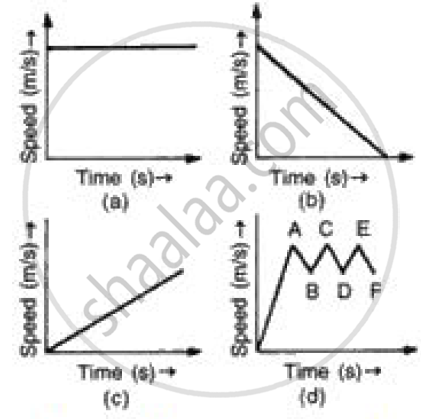
(i) In speed time graph uniform motion is given by a straight line parallel to x axis so figure (a) denotes the uniform motion.
(ii) In speed time graph motion with increasing speed is shown by straight line with positive slope so figure (c) denotes the motion with speed increasing.
(iii) In speed time graph motion with decreasing speed is shown by straight line with negative slope so figure (b) denotes the motion with speed decreasing.
(iv) In speed time graph motion with oscillating speed is shown by zigzag line so figure {d) denotes the motion with speed oscillating.
Figure represents graphically the velocity of a car moving along a straight road over a period of 100 hours.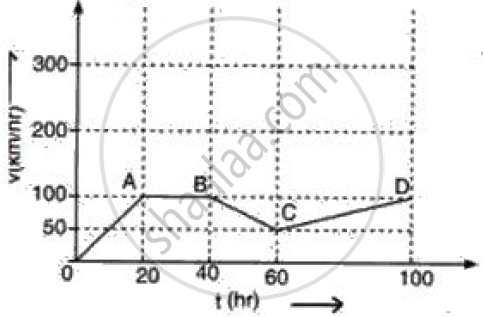
How long is the body travelling with a uniform velocity?
Figure represents graphically the velocity of a car moving along a straight road over a period of 100 hours.
Calculate the acceleration along AB and the retardation along BC.
The figure represents graphically the velocity of a car moving along a straight road over a period of 100 hours.
Calculate the distance travelled in the last 40 h.
Write down the type of motion of a body in each of the following distance time-graph.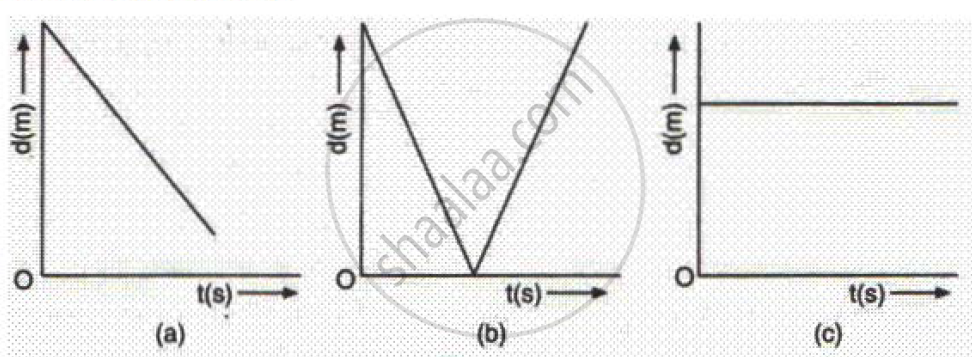
The table below shows the distance travelled by two vehicles A and B during each second:
| Time (s) | 0 | 1 | 2 | 3 | 4 | 5 | 6 | 7 |
| Distance travelled by A (m) | 0 | 20 | 80 | 180 | 240 | 300 | 360 | 420 |
| Distance travelled by B (m) | 0 | 10 | 40 | 90 | 160 | 250 | 360 | 490 |
Which vehicle is moving with uniform velocity?
The table below shows the distance travelled by two vehicles A and B during each second:
| Time (s) | 0 | 1 | 2 | 3 | 4 | 5 | 6 | 7 |
| Distance travelled by A (m) | 0 | 20 | 80 | 180 | 240 | 300 | 360 | 420 |
| Distance travelled by B (m) | 0 | 10 | 40 | 90 | 160 | 250 | 360 | 490 |
Which vehicle is moving with a constant acceleration?
The table below shows the distance travelled by two vehicles A and B during each second:
| Time (s) | 0 | 1 | 2 | 3 | 4 | 5 | 6 | 7 |
| Distance travelled by A (m) | 0 | 20 | 80 | 180 | 240 | 300 | 360 | 420 |
| Distance travelled by B (m) | 0 | 10 | 40 | 90 | 160 | 250 | 360 | 490 |
At what time do A and B meet?Which vehicle is moving with a constant acceleration?
The table below shows the distance travelled by two vehicles A and B during each second:
| Time (s) | 0 | 1 | 2 | 3 | 4 | 5 | 6 | 7 |
| Distance travelled by A (m) | 0 | 20 | 80 | 180 | 240 | 300 | 360 | 420 |
| Distance travelled by B (m) | 0 | 10 | 40 | 90 | 160 | 250 | 360 | 490 |
Give the value of the velocity at which they are meeting
The table below shows the distance travelled by two vehicles A and B during each second:
| Time (s) | 0 | 1 | 2 | 3 | 4 | 5 | 6 | 7 |
| Distance travelled by A (m) | 0 | 20 | 80 | 180 | 240 | 300 | 360 | 420 |
| Distance travelled by B (m) | 0 | 10 | 40 | 90 | 160 | 250 | 360 | 490 |
Which vehicle is ahead at the end of 7th second and by how much?
An object covers a distance of S meters in t seconds as follows :
| S (meters) | 0 | 8 | 20 | 20 | 16 | 10 | 0 |
| t (Seconds) | 80 | 2 | 5 | 10 | 12 | 15 | 10 |
Plot a graph, taking t on X-axis and S on Y-axis. Determine the velocity of the object at time
(i) 6 s, and
(ii) 14 s.
Solutions for 2: Motion in One Dimension
Frank solutions for Physics [English] Class 9 ICSE chapter 2 - Motion in One Dimension
Shaalaa.com has the CISCE Mathematics Physics [English] Class 9 ICSE CISCE solutions in a manner that help students grasp basic concepts better and faster. The detailed, step-by-step solutions will help you understand the concepts better and clarify any confusion. Frank solutions for Mathematics Physics [English] Class 9 ICSE CISCE 2 (Motion in One Dimension) include all questions with answers and detailed explanations. This will clear students' doubts about questions and improve their application skills while preparing for board exams.
Further, we at Shaalaa.com provide such solutions so students can prepare for written exams. Frank textbook solutions can be a core help for self-study and provide excellent self-help guidance for students.
Concepts covered in Physics [English] Class 9 ICSE chapter 2 Motion in One Dimension are Types of Velocity, Types of Acceleration, Types of Speed, Scalar and Vector Quantities, Velocity - Time Graphs, Measuring the Rate of Motion - Speed with Direction, Distance and Displacement, Acceleration and Retardation, Rate of Change of Velocity, Force and Motion, Motion Along a Straight Line, Speed, Velocity, Distinguish Between Speed and Velocity, Acceleration Due to Gravity (Earth’s Gravitational Acceleration), Graphical Representation of Motion, Displacement - Time Graph Or Distance - Time Graph, Acceleration - Time Graph, Motion Under Gravity, Equations of Motion by Graphical Method, Derivation of Velocity - Time Relation by Graphical Method.
Using Frank Physics [English] Class 9 ICSE solutions Motion in One Dimension exercise by students is an easy way to prepare for the exams, as they involve solutions arranged chapter-wise and also page-wise. The questions involved in Frank Solutions are essential questions that can be asked in the final exam. Maximum CISCE Physics [English] Class 9 ICSE students prefer Frank Textbook Solutions to score more in exams.
Get the free view of Chapter 2, Motion in One Dimension Physics [English] Class 9 ICSE additional questions for Mathematics Physics [English] Class 9 ICSE CISCE, and you can use Shaalaa.com to keep it handy for your exam preparation.
