Advertisements
Advertisements
प्रश्न
The initial velocity of a car is 10 ms-1. It moves with an acceleration of 2 ms-2. What will be its speed after 10 seconds?
Advertisements
उत्तर
Initial velocity u =10 ms-1.
Acceleration a = 2 ms-2.
Time t = 10 s.
By using first equation of motion
V = u + at.
V = 10 + 2 X 10.
V (final velocity) = 30 ms-1.
APPEARS IN
संबंधित प्रश्न
Define acceleration. State its unit.
A bullet initially moving with a velocity 20 m/s strikes a target and comes to rest after penetrating a distance 10 cm into the target. Calculate the retardation caused by the target.
A racing car is moving with a velocity of 50 m/s. On
applying brakes, it is uniformly retarded and comes to rest in 20 seconds. Calculate its acceleration.
A truck running at 90 kmh−1, is brought to rest over a distance of 25 m. Calculate the retardation and time for which brakes are applied.
What is the SI unit of acceleration?
Convert the following acceleration:
7200 km/h2 into m/s2
The graph shows how the velocity of a scooter varies with time in 50 s.
Work out: Deceleration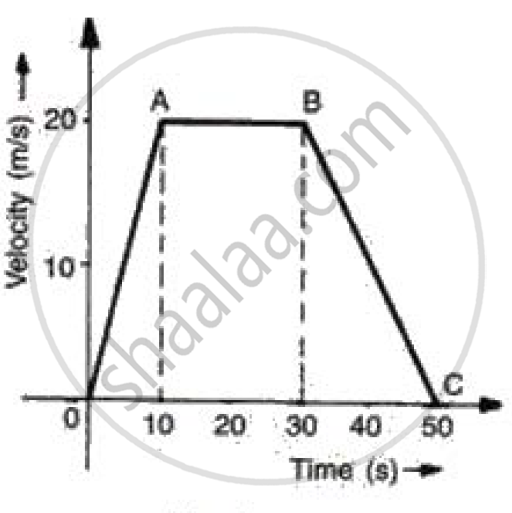
If the velocity of a body does not change, then its acceleration is ______.
Assertion: A positive acceleration of a body can be associated with the slowing down of the body.
Reason: Acceleration is a vector.
Assertion: When a body is subjected to a uniform acceleration, it is always moving in a straight line.
Reason: Motion may be straight-line motion or circular motion.
