Advertisements
Advertisements
प्रश्न
Sketch the shape of the velocity-time graph for a body moving with:
Uniform acceleration.
Advertisements
उत्तर

APPEARS IN
संबंधित प्रश्न
A toy car initially moving with uniform velocity of 18 km h-1 comes to a stop in 2 s. Find the retardation of the car in S.I. units.
The velocity-time graph for a uniformly retarded body is a straight line inclined to the time axis with an obtuse angle. How is retardation calculated from the velocity-time graph?
A car traveling at 60 km/h, stops on applying brakes in 10 seconds. What is its acceleration?
State if the following situation is possible:
A body moving with a constant velocity in an accelerated motion.
What happens to the stepwise increasing speed-time graph when the size of each step is made very small?
The graph shows how the velocity of a scooter varies with time in 50 s.
Work out: Acceleration.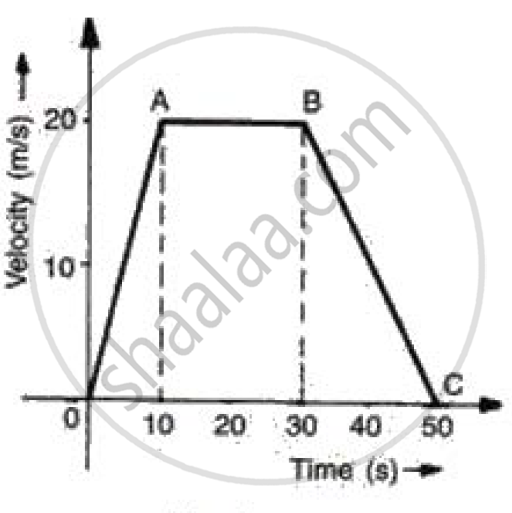
m/s2 is the unit of ______.
Acceleration is defined as the rate of change of ______.
Assertion: A positive acceleration of a body can be associated with the slowing down of the body.
Reason: Acceleration is a vector.
