Advertisements
Advertisements
प्रश्न
The speed of a car increases from 10 km/h to 64 km/h in 10 seconds. What will be its acceleration?
Advertisements
उत्तर
Initial velocity u = 10 km/hr. = (10 X 1000)/3600 = 8.33 ms-1.
Final velocity = 64 km/hr = (64 X 1000)/3600 = 17.77 ms-1.
Time = 10 s.
Acceleration = (v-u)/t = (17.77- 8.33)/10 = 9.44/10 = 0.94 ms-2.
APPEARS IN
संबंधित प्रश्न
Figure given below shows a velocity-time graph for a car starting from rest. The graph has three parts AB, BC and CD.
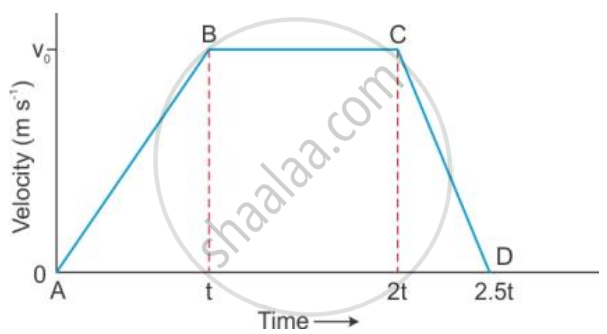
Which part of graph shows motion with uniform
(a) velocity (b) acceleration (c) retardation ?
A bullet initially moving with a velocity 20 m/s strikes a target and comes to rest after penetrating a distance 10 cm into the target. Calculate the retardation caused by the target.
A train starts from rest and accelerates uniformly at a rate of 2 m s−2 for 10 s. It then maintains a constant speed for 200 s. The brakes are then applied and the train is uniformly retarded and comes to rest in 50 s. Find
- The maximum velocity reached,
- The retardation in the last 50 s,
- The total distance travelled,
- The average velocity of the train.
What is the SI unit of acceleration?
Write the SI unit of retardation.
Convert the following acceleration:
1/36 m/s2 into km/h2
Acceleration is a scalar.
Assertion: A positive acceleration of a body can be associated with the slowing down of the body.
Reason: Acceleration is a vector.
Assertion: A negative acceleration of a body can be associated with speeding up of the body.
Reason: Increase in the speed of a moving body is independent of its direction of motion.
What is the difference between uniform acceleration and non–uniform acceleration?
