Advertisements
Advertisements
Question
The speed of a car increases from 10 km/h to 64 km/h in 10 seconds. What will be its acceleration?
Advertisements
Solution
Initial velocity u = 10 km/hr. = (10 X 1000)/3600 = 8.33 ms-1.
Final velocity = 64 km/hr = (64 X 1000)/3600 = 17.77 ms-1.
Time = 10 s.
Acceleration = (v-u)/t = (17.77- 8.33)/10 = 9.44/10 = 0.94 ms-2.
APPEARS IN
RELATED QUESTIONS
What is meant by the term retardation? Name its S.I. unit.
Figure given below shows a velocity-time graph for a car starting from rest. The graph has three parts AB, BC and CD.
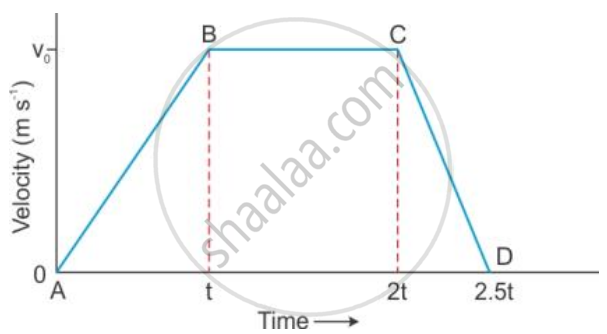
(a) Is the magnitude of acceleration higher or lower than that of retardation ? Give a reason .
(b) Compare the magnitude of acceleration and retardation .
When is the acceleration due to gravity negative?
The distance covered by a body is directly proportional to the square of the time elapsed. What can you say about its acceleration?
A car is moving with a speed of 50 km/h. One second later, its speed is 55 km/h. What is its acceleration?
A car accelerates to a velocity of 30 m/s in 10 s and then decelerates for 20 s so that it stops. Draw a velocity-time graph to represent the motion and find:
The acceleration.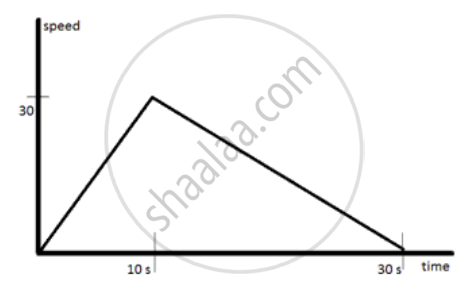
What is meant by negative acceleration?
When an object undergoes acceleration ______.
A quantity has a value of 16ms-2. It is the ______.
The value of acceleration for a body at rest is ______.
