Advertisements
Advertisements
Question
A ball is rolling from A to D on a flat and smooth surface. Its speed is 2 cm/s. On reaching B, it was pushed continuously up to C. On reaching D from C, its speed had become 4 cm/s. It took 2 seconds for it to go from B to C. What is the acceleration of the ball as it goes from B to C?

Advertisements
Solution
The acceleration of the ball between A to B is zero as the speed and direction of the ball are constant. After point B, a force is applied. Thus, the ball will get accelerated.
`"Acceleration of the ball from B to C" = "Change in velocity from B to C"/"Time taken for this change"`
`"Acceleration of the ball from B to C" = (4 - 2)/2 = 1m"/"s^2`
RELATED QUESTIONS
Distinguish between acceleration and retardation.
Define the term acceleration due to gravity. State its average value.
If a body is moving with a constant velocity its acceleration is ______.
The change in velocity of a motorbike is 54 kmh−1 in one minute. Calculate its acceleration in (a) ms−2 (b) kmh−2.
Draw velocity – time graph for the following situation:
When a body is moving with variable velocity and variable acceleration.
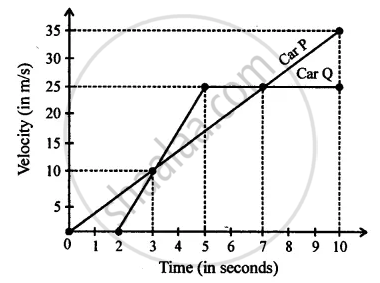
Diagram is given below shows velocity – time graph of car P and Q, starting from the same place and in the same direction. Calculate the Acceleration of car Q between 2 s – 5 s.
State if the following situation is possible:
A body moving horizontally with an acceleration in vertical direction.
Convert the following acceleration:
7200 km/h2 into m/s2
A car accelerates to a velocity of 30 m/s in 10 s and then decelerates for 20 s so that it stops. Draw a velocity-time graph to represent the motion and find:
The acceleration.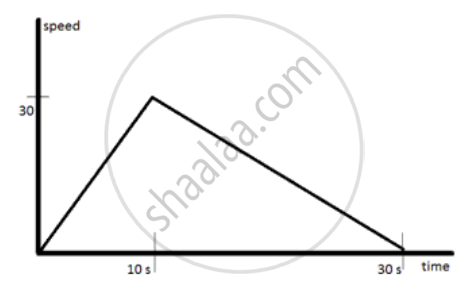
An object can be moving with uniform speed but with variable acceleration.
