Advertisements
Advertisements
प्रश्न
A ball is rolling from A to D on a flat and smooth surface. Its speed is 2 cm/s. On reaching B, it was pushed continuously up to C. On reaching D from C, its speed had become 4 cm/s. It took 2 seconds for it to go from B to C. What is the acceleration of the ball as it goes from B to C?

Advertisements
उत्तर
The acceleration of the ball between A to B is zero as the speed and direction of the ball are constant. After point B, a force is applied. Thus, the ball will get accelerated.
`"Acceleration of the ball from B to C" = "Change in velocity from B to C"/"Time taken for this change"`
`"Acceleration of the ball from B to C" = (4 - 2)/2 = 1m"/"s^2`
संबंधित प्रश्न
Figure given below shows a velocity-time graph for a car starting from rest. The graph has three parts AB, BC and CD.
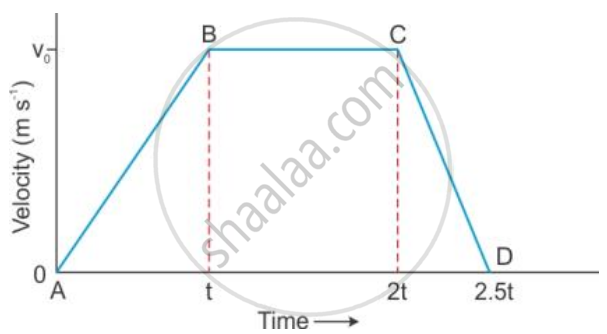
(a) Is the magnitude of acceleration higher or lower than that of retardation ? Give a reason .
(b) Compare the magnitude of acceleration and retardation .
A space craft flying in a straight course with velocity of 75 km s-1 fires its rocket motors for 6.0 s. At the end of this time its speed is 120 km s-1 in the same direction.
Find
(i) The space craft's average acceleration while the motors were firing
(ii) The distance travelled by the space craft in the first 10 s after the rocket motors were started, the motors being in action for only 6 s.
Draw velocity – time graph for the following situation:
When a body is moving with variable velocity and variable acceleration.
An aeroplane lands at 216 kmh−1 and stops after covering a runway of 2 m. Calculate the acceleration and the time, in which it comes to rest.
What does a positive acceleration mean?
The acceleration of a body is 8.5 ms-2. What does this statement mean?
A body has an acceleration of -3.5 ms-2. What is its retardation?
A car accelerates to a velocity of 30 m/s in 10 s and then decelerates for 20 s so that it stops. Draw a velocity-time graph to represent the motion and find:
The Deceleration.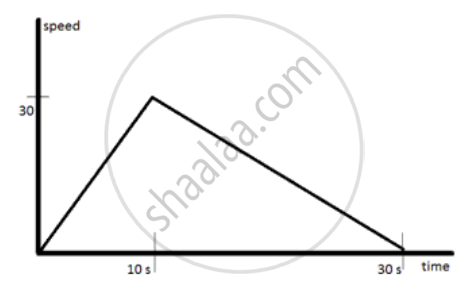
What do you understand about negative acceleration?
Acceleration is defined as the rate of change of ______.
