Advertisements
Advertisements
Question
A car accelerates uniformly from a velocity of 18 km/h to 36 km/h in 15 min. What is its acceleration?
Advertisements
Solution
Initial velocity of car u = 18 km/hr.
Final velocity of car v= 36 km/hr.
Time taken by body = 15 min. = 1/4 hr
Acceleration of car a = ( v- u )/t = (36 - 18 ) X 4 = 72 kmh-2.
APPEARS IN
RELATED QUESTIONS
A car travels with uniform velocity of 25 m s-1 for 5 s. The brakes are then applied and the car is uniformly retarded and comes to rest in further 10 s. Find:
- The distance which the car travels before the brakes are applied,
- Retardation and
- The distance travelled by car after applying the brakes.
Give an example of an accelerated body, moving with a uniform speed.
Draw velocity – time graph for the following situation:
When a body is moving with variable velocity, but uniform retardation.
A racing car is moving with a velocity of 50 m/s. On
applying brakes, it is uniformly retarded and comes to rest in 20 seconds. Calculate its acceleration.
Diagram is given below shows velocity – time graph of car P and Q, starting from the same place and in the same direction. Calculate the Acceleration of car P.
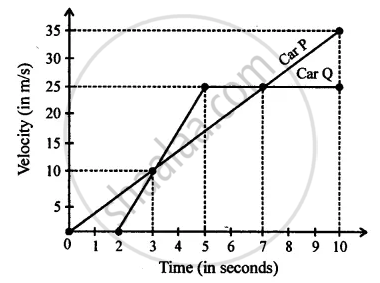
Diagram is given below shows velocity – time graph of car P and Q, starting from the same place and in the same direction. Calculate the Acceleration of car Q between 2 s – 5 s.
A cyclist driving at 5 ms−1, picks a velocity of 10 ms−1, over a distance of 50 m. Calculate
- acceleration
- time in which the cyclist picks up above velocity.
The acceleration of a moving body is constant in magnitude and direction. Must the path of the body be a straight line?
If not, given an example.
Write the SI unit of retardation.
Sketch the shape of the velocity-time graph for a body moving with:
Uniform acceleration.
