Advertisements
Advertisements
Question
State its value in C.G.S. as well as in S.I. system.
Advertisements
Solution
In S.I. system, g = 9.8 ms−2; In C.GS. system, g = 980 cms−2
RELATED QUESTIONS
What is meant by the term retardation? Name its S.I. unit.
A body is moving vertically upwards. Its velocity changes at a constant rate from 50 m s−1 to 20 m s−1 in 3 s. What is its acceleration?
Figure given below shows a velocity-time graph for a car starting from rest. The graph has three parts AB, BC and CD.
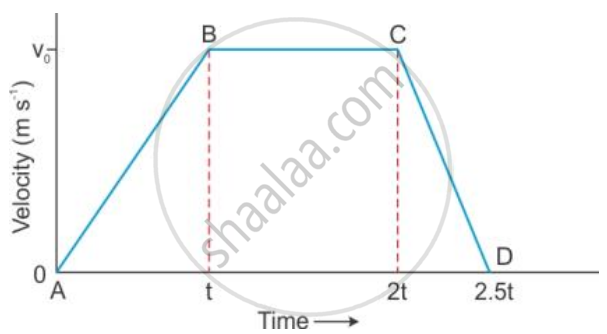
(a) Is the magnitude of acceleration higher or lower than that of retardation ? Give a reason .
(b) Compare the magnitude of acceleration and retardation .
If a body is moving with a constant velocity its acceleration is ______.
A ball is rolling from A to D on a flat and smooth surface. Its speed is 2 cm/s. On reaching B, it was pushed continuously up to C. On reaching D from C, its speed had become 4 cm/s. It took 2 seconds for it to go from B to C. What is the acceleration of the ball as it goes from B to C?

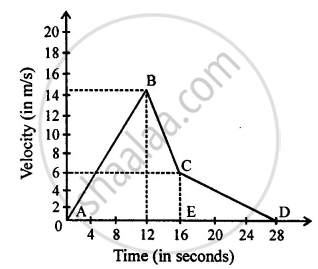
From the velocity – time graph given below, calculate deceleration in region BC.
What happens to the stepwise increasing speed-time graph when the size of each step is made very small?
The graph shows how the velocity of a scooter varies with time in 50 s.
Work out: Deceleration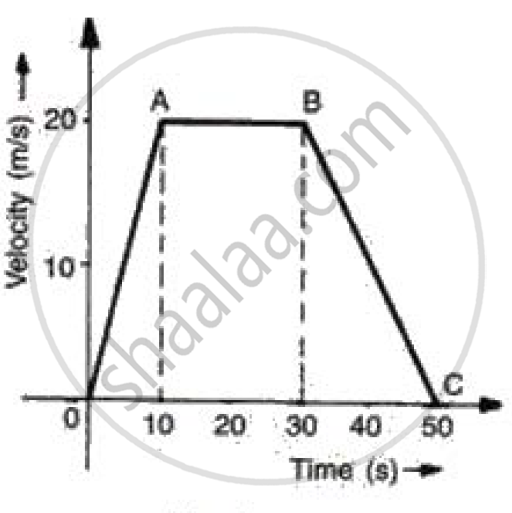
The rate of change of velocity is ______.
Exercise Problem.
A racing car has a uniform acceleration of 4 ms–2. What distance it covers in 10 s after the start?
