Advertisements
Advertisements
Question
Figure given below shows a velocity-time graph for a car starting from rest. The graph has three parts AB, BC and CD.
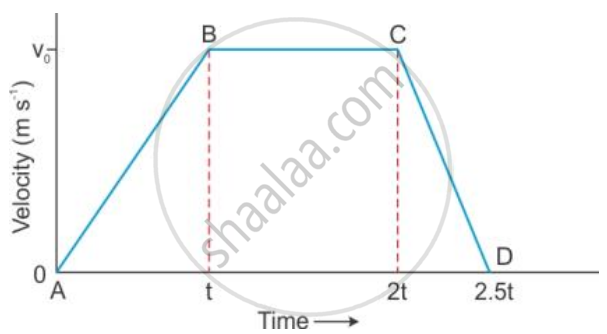
(a) Is the magnitude of acceleration higher or lower than that of retardation ? Give a reason .
(b) Compare the magnitude of acceleration and retardation .
Advertisements
Solution
(a) The magnitude of acceleration is lower as the slope of line AB is less than that of line CD.
(b) Slope of line AB = vo/t
Slope of line CD = vo/0.5t
Slope of line AB/Slope of line CD = (vo /t)/(vo /0.5t)
Slope of line AB:Slope of line CD :: 1:2.
APPEARS IN
RELATED QUESTIONS
A body is moving vertically upwards. Its velocity changes at a constant rate from 50 m s−1 to 20 m s−1 in 3 s. What is its acceleration?
A train starts from rest and accelerates uniformly at a rate of 2 m s−2 for 10 s. It then maintains a constant speed for 200 s. The brakes are then applied and the train is uniformly retarded and comes to rest in 50 s. Find
- The maximum velocity reached,
- The retardation in the last 50 s,
- The total distance travelled,
- The average velocity of the train.
When is the acceleration due to gravity positive?
From the velocity – time graph given below, calculate deceleration in region BC.
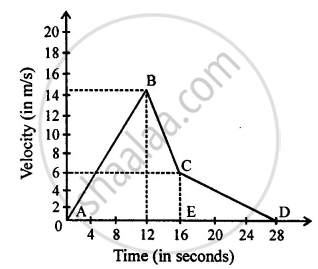
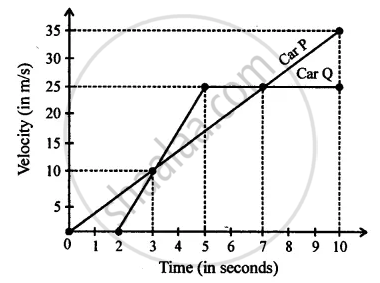
Diagram is given below shows velocity – time graph of car P and Q, starting from the same place and in the same direction. Calculate the Acceleration of car Q between 2 s – 5 s.
A cyclist driving at 36 kmh−1 stops his motion in 2 s, by the application of brakes. Calculate
- retardation
- distance covered during the application of brakes.
The acceleration of a body is 8.5 ms-2. What does this statement mean?
The distance covered by a body is directly proportional to the square of the time elapsed. What can you say about its acceleration?
A car accelerates to a velocity of 30 m/s in 10 s and then decelerates for 20 s so that it stops. Draw a velocity-time graph to represent the motion and find:
The acceleration.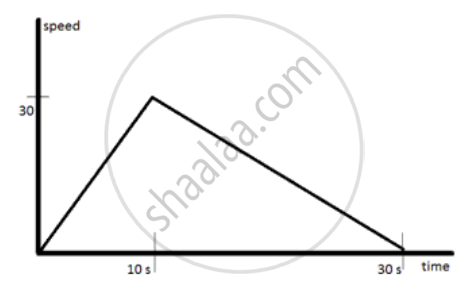
The Unit of acceleration is ______.
