Advertisements
Advertisements
Question
Figure given below shows a velocity-time graph for a car starting from rest. The graph has three parts AB, BC and CD.
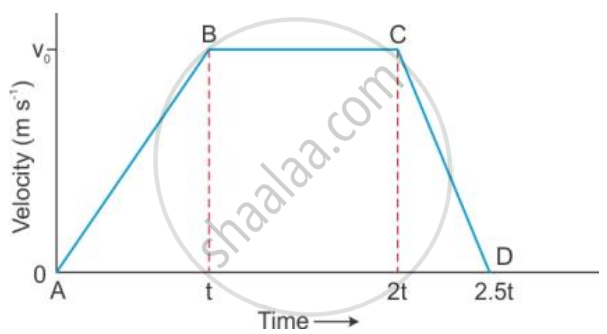
Which part of graph shows motion with uniform
(a) velocity (b) acceleration (c) retardation ?
Advertisements
Solution
(a) BC shows motion with uniform velocity.
(b) AB shows motion with uniform acceleration.
(c) CD shows motion with uniform retardation.
APPEARS IN
RELATED QUESTIONS
Distinguish between acceleration and retardation.
The unit of retardation is ____________
The velocity-time graph for a uniformly retarded body is a straight line inclined to the time axis with an obtuse angle. How is retardation calculated from the velocity-time graph?
A body falls freely from a certain height. Show graphically the relation between the distance fallen and square of time. How will you determine g from this graph?
Define acceleration.
Is it possible for an accelerating body to have constant speed?
Correct your friend who says that acceleration gives the idea of how fast the position changes.
Exercise Problem.
A racing car has a uniform acceleration of 4 ms–2. What distance it covers in 10 s after the start?
m/s2 is the unit of ______.
The value of acceleration for a body at rest is ______.
