Advertisements
Advertisements
Question
Figure given below shows a velocity-time graph for a car starting from rest. The graph has three parts AB, BC and CD.
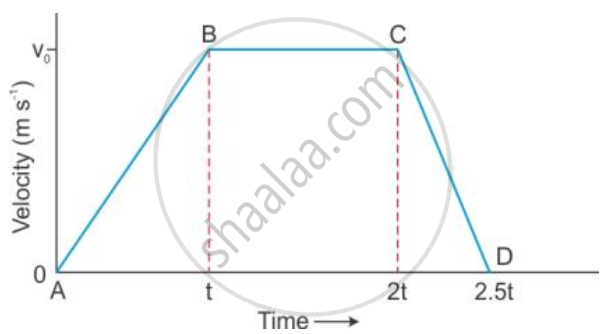
Compare the distance travelled in part BC with the distance travelled in part AB.
Advertisements
Solution
Distance travelled in part BC = Area of the rectangle tBC2t = base × height.
= (2t - t) × vo
= vot
Distance travelled in part AB = Area of the triangle ABt
= (1/2) × base × height
= (1/2) × t × vo
= (1/2) vo t
Therefore, distance travelled in part BC:distance travelled in part AB :: 2:1.
APPEARS IN
RELATED QUESTIONS
Can displacement be zero even if the distance is not zero? Give one example to explain your answer.
State how the velocity-time graph can be used to find The displacement of the body in a given time.
A body at rest is made to fall from the top of a tower. Its displacement at different instants is given in the following table:
| Time (in s) | 0.1 | 0.2 | 0.3 | 0.4 | 0.5 | 0.6 |
| Displacement (in m) | 0.05 | 0.20 | 0.45 | 0.80 | 1.25 | 1.80 |
Draw a displacement-time graph and state whether the motion is uniform or non-uniform?
A motor car slows down from 72 kmh−1 to 36 kmh−1 over a distance of 25 m. If the brakes are applied with the same force
calculate
- total time in which car comes to rest
- distance travelled by it.
Show the difference between distance and displacement with the help of a diagram.
A car travels at a uniform speed of 42 km/h. In 10 minutes, how much distance would it cover?
The table below shows the distance travelled by two vehicles A and B during each second:
| Time (s) | 0 | 1 | 2 | 3 | 4 | 5 | 6 | 7 |
| Distance travelled by A (m) | 0 | 20 | 80 | 180 | 240 | 300 | 360 | 420 |
| Distance travelled by B (m) | 0 | 10 | 40 | 90 | 160 | 250 | 360 | 490 |
At what time do A and B meet?Which vehicle is moving with a constant acceleration?
Displacement / Time : Velocity :: Speed / Time : ______.
An ant moves from one corner of a room diagonally to the opposite corner. If the dimensions of the hall are 8m x 6m, the displacement of the ant is ______.
Choose the correct option.
