Advertisements
Advertisements
प्रश्न
Figure given below shows a velocity-time graph for a car starting from rest. The graph has three parts AB, BC and CD.
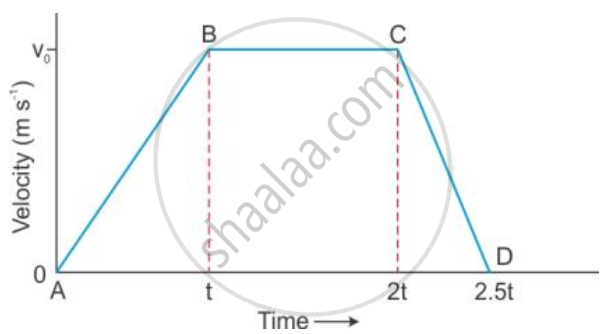
Compare the distance travelled in part BC with the distance travelled in part AB.
Advertisements
उत्तर
Distance travelled in part BC = Area of the rectangle tBC2t = base × height.
= (2t - t) × vo
= vot
Distance travelled in part AB = Area of the triangle ABt
= (1/2) × base × height
= (1/2) × t × vo
= (1/2) vo t
Therefore, distance travelled in part BC:distance travelled in part AB :: 2:1.
APPEARS IN
संबंधित प्रश्न
If the displacement of an object is proportional to the square of time, then the object is moving with :
Clarify the difference.
Distance and displacement
A car travels a distance 100 m with constant acceleration and average velocity of 20 ms-1. The final velocity acquired by the car is 25 ms-1.
Find
(i) The initial velocity.
(ii) Acceleration of the car.
Draw displacement – time graph for the following situation:
When a body is moving with variable velocity.
How can you find the following?
Velocity from a displacement – time graph.
A motorbike running at 90 kmh−1, is slowed down to 54 kmh−1 by the application of brakes, over a distance of 40 m. If the brakes are applied with the same force, calculate
- total time in which bike comes to rest
- total distance travelled by bike.
Define displacement.
Fill in the boxes.
| S.No | First Move | Seconde Move | Distance (m) | Displacement |
| 1. | Move 4 metres east | Move 2 metres west | 6 | 2 m east |
| 2. | Move 4 metres north | Move 2 metres south | ||
| 3. | Move 2 metres east | Move 4 metres west | ||
| 4. | Move 5 metres east | Move 5 metres west | ||
| 5. | Move 5 metres south | Move 2 metres north | ||
| 6. | Move 10 metres west | Move 3 metres east |
Exercise Problems.
An athlete completes one round of a circular track of diameter 200 m in 40 s. What will be the distance covered and the displacement at the end of 2 m and 20 s?
Give one example where the displacement is zero but the distance travelled is not zero.
