Advertisements
Advertisements
प्रश्न
Figure given below shows a velocity-time graph for a car starting from rest. The graph has three parts AB, BC and CD.
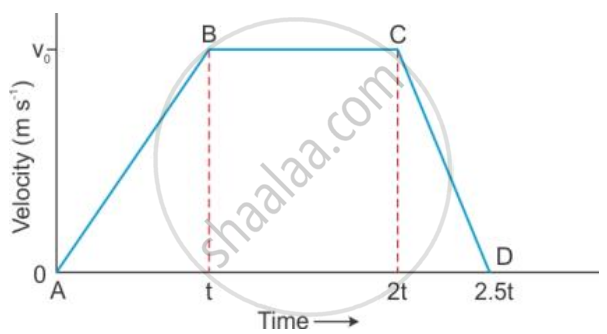
State how is the distance travelled in any part determined from this graph .
Advertisements
उत्तर
Distance travelled in any part of the graph can be determined by finding the area enclosed by the graph in that part with the time axis.
APPEARS IN
संबंधित प्रश्न
What information about the motion of a body are obtained from the displacement-time graph?
The following table gives the displacement of a car at different instants of time.
| Time (s) | 0 | 1 | 2 | 3 | 4 |
| Displacement (m) | 0 | 5 | 10 | 15 | 20 |
- Draw the displacement-time sketch and find the average velocity of the car.
- What will be the displacement of the car at (i) 2.5 s and (ii) 4.5 s?
A racehorse runs straight towards the north and covers 540 m in one minute. Calculate
- displacement of the horse,
- its velocity in (a) ms−1 (b) kmh−1.
Can distance covered by a body be less than the magnitude of its displacement?
A body is moving along a circular path of radius r. What will be the distance and displacement of the body when it completes:
Full revolution
Displacement / Time : Velocity :: Speed / Time : ______.
Slope of a velocity-time graph gives
If the displacement-time graph of a particle is parallel to the time axis, the velocity of the particle is ______.
Displacement is the ______ distance covered by a body.
Assertion: If the displacement of the body is zero, the distance covered by it may not be zero.
Reason: Displacement is a vector & distance is a scalar quantity.
