Advertisements
Advertisements
प्रश्न
A body is moving along a circular path of radius r. What will be the distance and displacement of the body when it completes:
Full revolution
Advertisements
उत्तर
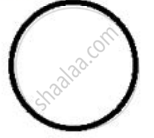
Distance travelled is =perimeter of circle.
So distance travelled is =2π r.
Displacement =0 as starting and ending point are coinciding.
APPEARS IN
संबंधित प्रश्न
State whether distance is a scalar or a vector quantity.
The displacement of a moving object in a given interval of time is zero. Would the distance travelled by the object also be zero ? Give reason for your answer.
Draw a velocity-time graph for a body moving with an initial velocity u and uniform acceleration a. Use this graph to find the distance travelled by the body in time t.
A car travels a distance 100 m with constant acceleration and average velocity of 20 ms-1. The final velocity acquired by the car is 25 ms-1.
Find
(i) The initial velocity.
(ii) Acceleration of the car.
Copy the following table and fill in the blank spaces.
| Quantity | S.I. Unit | Scalar or Vector |
| Displacement | ___________ | ___________ |
An object is thrown vertically upwards. It rises upto a height H and then returns to its initial position. Calculate
The total distance traveled by the object
The shortest distance between two places is ______.
The SI unit of displacement is ______.
The displacement of a moving object in a given interval of time is zero. Would the distance travelled by the object also be zero? Justify your answer.
A car starts from rest and moves along the x-axis with constant acceleration 5 ms–2 for 8 seconds. If it then continues with constant velocity, what distance will the car cover in 12 seconds since it started from the rest?
