Advertisements
Advertisements
प्रश्न
A body is moving along a circular path of radius r. What will be the distance and displacement of the body when it completes:
`(3/4)` th of a revolution
Advertisements
उत्तर
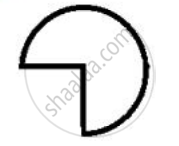
Distance travelled = (3/ 4) of perimeter of circle.
So distance travelled is = (3π r/ 2).
Displacement can be calculated ass = √r2+r2 = √2r.
APPEARS IN
संबंधित प्रश्न
An athlete completes one round of a circular track of diameter 200 m in 40 s. What will be the distance covered and the displacement at the end of 2 minutes 20 s?
Under what conditions can a body travel a certain distance and yet its resultant displacement be zero ?
Clarify the difference.
Distance and displacement
The minimum distance between the start and finish points of the motion of an object is called the ______ of the object.
What information about the motion of a body are obtained from the displacement-time graph?
What can you say about the nature of motion of a body if its displacement-time graph is A straight line inclined to the time axis with an acute angle?
Define Distance.
How can you find the following?
Displacement from velocity – time graph.
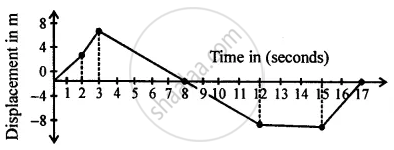
From the displacement – time graph shown given below calculate:
- Average velocity in the first three seconds.
- Displacement from the initial position at the end of 13 s.
- Time after which the body is at the initial position,
- Average velocity after 8 s.
The table below shows the distance travelled by two vehicles A and B during each second:
| Time (s) | 0 | 1 | 2 | 3 | 4 | 5 | 6 | 7 |
| Distance travelled by A (m) | 0 | 20 | 80 | 180 | 240 | 300 | 360 | 420 |
| Distance travelled by B (m) | 0 | 10 | 40 | 90 | 160 | 250 | 360 | 490 |
Which vehicle is moving with uniform velocity?
