Advertisements
Advertisements
प्रश्न
A body is moving along a circular path of radius r. What will be the distance and displacement of the body when it completes:
Half a revolution
Advertisements
उत्तर
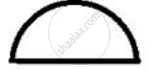
In this case Distance travelled =half of the parameter of circle.
So distance travelled is =n r. Displacement= diameter of circle
So displacement is 2r.
APPEARS IN
संबंधित प्रश्न
If on a round trip you travel 6 km and then arrive back home :
What is your final displacement ?
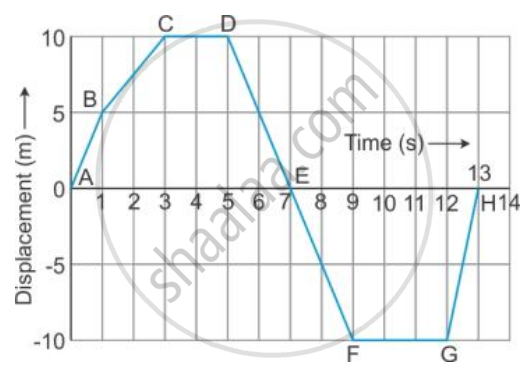
From the displacement-time graph of a cyclist given below in the Figure, find The displacement from the initial position at the end of 10 s,
Copy the following table and fill in the blank spaces.
| Quantity | S.I. Unit | Scalar or Vector |
| Displacement | ___________ | ___________ |
How can you find the following?
Velocity from a displacement – time graph.
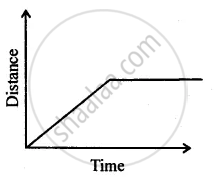
Can you suggest the kind of motion of a body from the following distance – time graph?
Can distance covered by a body be less than the magnitude of its displacement?
Show the difference between distance and displacement with the help of a diagram.
A body is moving along a circular path of radius r. What will be the distance and displacement of the body when it completes:
Full revolution
The figure represents graphically the velocity of a car moving along a straight road over a period of 100 hours.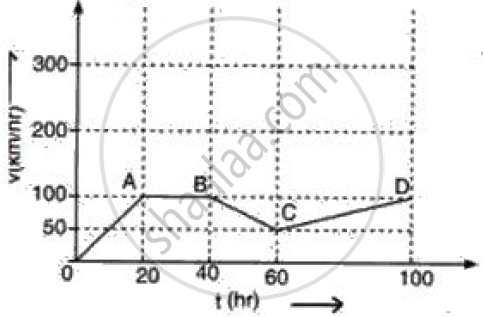
Calculate the distance travelled in the last 40 h.
Distance travelled by a freely falling body is proportional to ______.
