Advertisements
Advertisements
प्रश्न
How can you find the following?
Velocity from a displacement – time graph.
Advertisements
उत्तर
Velocity from a displacement – time graph: Displacement time graph for uniform motion in a straight line (OP) inclined to the time axis. Take any two points A and B on this graph OP. From A and B, draw perpendiculars on the time axis as well as the displacement axis.
So, by knowing the slope of displacement – time graph. We can find the velocity of the body.
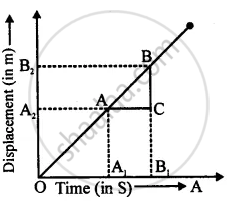
Such that,
OA1 = t1, OB1 = t2, OA2 = x1 and OB2 = x2
Slope of displacement – time graph = `"BC"/"AC"`
= `("x"_2-"x"_1)/("t"_2-"t"_1)=(Δ"x")/(Δ"t")` = Velocity of the body
APPEARS IN
संबंधित प्रश्न
If the displacement of an object is proportional to the square of time, then the object is moving with :
State how the velocity-time graph can be used to find The displacement of the body in a given time.
What can you say about the nature of motion of a body if its displacement-time graph is A curve.
A bird sitting on a wire, flies, circles around and comes back to its perch. Explain the total distance it traversed during its flight and its eventual displacement.
Can a body have negative displacement?
A car travels at a uniform speed of 42 km/h. In 10 minutes, how much distance would it cover?
Match the following.
| 1. | Displacement | Knot |
| 2. | Light travelling through vacuum | Geometric centre |
| 3. | Speed of ship | Metre |
| 4. | Centre of gravity of geometrical shaped objects | Larger base area |
| 5. | Stability | Uniform velocity |
Fill in the boxes.
| S.No | First Move | Seconde Move | Distance (m) | Displacement |
| 1. | Move 4 metres east | Move 2 metres west | 6 | 2 m east |
| 2. | Move 4 metres north | Move 2 metres south | ||
| 3. | Move 2 metres east | Move 4 metres west | ||
| 4. | Move 5 metres east | Move 5 metres west | ||
| 5. | Move 5 metres south | Move 2 metres north | ||
| 6. | Move 10 metres west | Move 3 metres east |
A car starts from rest and moves along the x-axis with constant acceleration 5 ms–2 for 8 seconds. If it then continues with constant velocity, what distance will the car cover in 12 seconds since it started from the rest?
Distance travelled by a freely falling body is proportional to ______.
