Advertisements
Advertisements
प्रश्न
An object covers a distance of S meters in t seconds as follows :
| S (meters) | 0 | 8 | 20 | 20 | 16 | 10 | 0 |
| t (Seconds) | 80 | 2 | 5 | 10 | 12 | 15 | 10 |
Plot a graph, taking t on X-axis and S on Y-axis. Determine the velocity of the object at time
(i) 6 s, and
(ii) 14 s.
Advertisements
उत्तर
The given question is wrong as distance can never DECREASE with the progress of time.
APPEARS IN
संबंधित प्रश्न
Clarify the difference.
Distance and displacement
State how the velocity-time graph can be used to find The distance travelled by the body in a given time
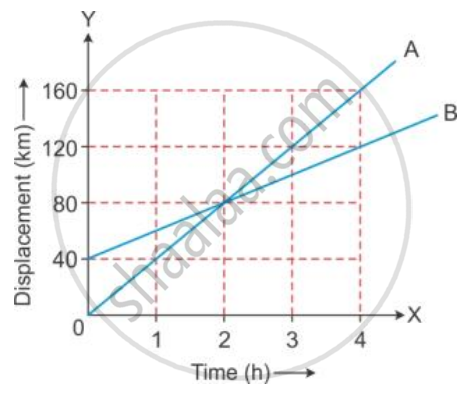
Figure ahead represents the displacement - time sketch of motion of two cars A and B . Find :
(i) the distance by which the car B was initially ahead of car A.
(ii) the velocities of car A and car B.
(iii) the time in which car A catches car B.
(iv) the distance from start when the car A will catch the car B.
A car starting from rest accelerates uniformly to acquire a speed 20 km h-1 in 30 min. The distance travelled by a car in this time interval will be _____________
A car travels a distance 100 m with constant acceleration and average velocity of 20 ms-1. The final velocity acquired by the car is 25 ms-1.
Find
(i) The initial velocity.
(ii) Acceleration of the car.
Give two differences between displacement and distance.
How can you find the following?
Velocity from a displacement – time graph.
A satellite makes a complete round along its circular orbit. What is its displacement?
The table below shows the distance travelled by two vehicles A and B during each second:
| Time (s) | 0 | 1 | 2 | 3 | 4 | 5 | 6 | 7 |
| Distance travelled by A (m) | 0 | 20 | 80 | 180 | 240 | 300 | 360 | 420 |
| Distance travelled by B (m) | 0 | 10 | 40 | 90 | 160 | 250 | 360 | 490 |
Give the value of the velocity at which they are meeting
Assertion: If the displacement of the body is zero, the distance covered by it may not be zero.
Reason: Displacement is a vector & distance is a scalar quantity.
