Advertisements
Advertisements
Question
An object covers a distance of S meters in t seconds as follows :
| S (meters) | 0 | 8 | 20 | 20 | 16 | 10 | 0 |
| t (Seconds) | 80 | 2 | 5 | 10 | 12 | 15 | 10 |
Plot a graph, taking t on X-axis and S on Y-axis. Determine the velocity of the object at time
(i) 6 s, and
(ii) 14 s.
Advertisements
Solution
The given question is wrong as distance can never DECREASE with the progress of time.
APPEARS IN
RELATED QUESTIONS
If on a round trip you travel 6 km and then arrive back home :
What distance have you travelled ?
The numerical ratio of displacement to distance for a moving object is :
What can you say about the nature of motion of a body if its displacement-time graph is A straight line inclined to the time axis with an acute angle?
How can you find the following?
Velocity from a displacement – time graph.
Calculate the distance and displacement in the following case: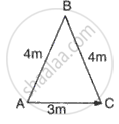
Calculate the distance and displacement in the following case: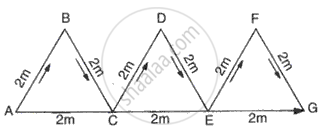
The table below shows the distance travelled by two vehicles A and B during each second:
| Time (s) | 0 | 1 | 2 | 3 | 4 | 5 | 6 | 7 |
| Distance travelled by A (m) | 0 | 20 | 80 | 180 | 240 | 300 | 360 | 420 |
| Distance travelled by B (m) | 0 | 10 | 40 | 90 | 160 | 250 | 360 | 490 |
At what time do A and B meet?Which vehicle is moving with a constant acceleration?
Four cars A, B, C, and D are moving on a levelled road. Their distance versus time graphs are shown in Fig. 8.2. Choose the correct statement.

Give one example where the displacement is zero but the distance travelled is not zero.
Displacement magnitude can be greater than the distance traveled by the object.
