Advertisements
Advertisements
Question
An object is thrown vertically upwards. It rises upto a height H and then returns to its initial position. Calculate
The displacement of the object.
Advertisements
Solution
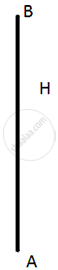
Total displacement =0 as starting and ending points are coinciding.
APPEARS IN
RELATED QUESTIONS
Differentiate between distance and displacement.
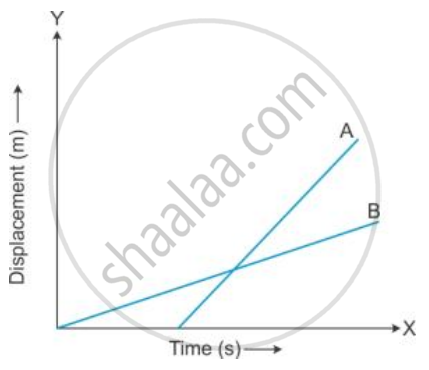
Figure shows the displacement-time graph of two vehicles A and B moving along a straight road. Which vehicle is moving faster? Give reason.
Define Distance.
Give the name of the physical quantity that corresponds to the rate of change of displacement.
A particle moves along a circular path. How many times does it change its direction in two complete rounds?
Fill in the boxes.
| S.No | First Move | Seconde Move | Distance (m) | Displacement |
| 1. | Move 4 metres east | Move 2 metres west | 6 | 2 m east |
| 2. | Move 4 metres north | Move 2 metres south | ||
| 3. | Move 2 metres east | Move 4 metres west | ||
| 4. | Move 5 metres east | Move 5 metres west | ||
| 5. | Move 5 metres south | Move 2 metres north | ||
| 6. | Move 10 metres west | Move 3 metres east |
The SI unit of displacement is ______.
Slope of a velocity-time graph gives
The rate of change of displacement ______.
A quantity that has both magnitude and direction is ______.
