Advertisements
Advertisements
Question
A particle moves along a circular path. How many times does it change its direction in two complete rounds?
Advertisements
Solution
As in circular motion direction changes continuously with motion so after two complete revolutions we can say that direction has changed infinite times.
APPEARS IN
RELATED QUESTIONS
An ant travels a distance of 8 cm from P to Q and then moves a distance of 6 cm at right angles to PQ. Find its resultant displacement.
Can displacement be zero even if the distance is not zero? Give one example to explain your answer.
Draw a velocity-time graph for a body moving with an initial velocity u and uniform acceleration a. Use this graph to find the distance travelled by the body in time t.
Figure given below shows a velocity-time graph for a car starting from rest. The graph has three parts AB, BC and CD.
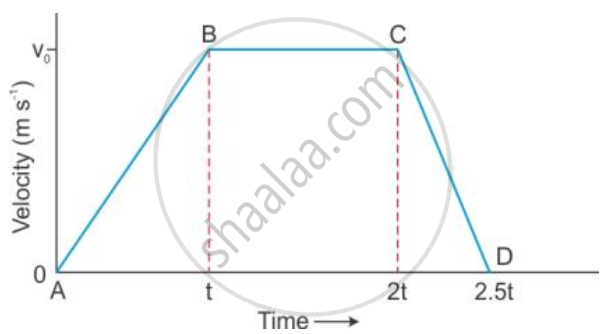
Compare the distance travelled in part BC with the distance travelled in part AB.
Define displacement.
Under what condition is the displacement of a body equal to the distance traveled by it?
A body is moving along a circular path of radius r. What will be the distance and displacement of the body when it completes:
Two full revolutions
A satellite makes a complete round along its circular orbit. What is its displacement?
Distinguish distance and displacement.
Distance travelled by a freely falling body is proportional to ______.
