Advertisements
Advertisements
प्रश्न
A particle moves along a circular path. How many times does it change its direction in two complete rounds?
Advertisements
उत्तर
As in circular motion direction changes continuously with motion so after two complete revolutions we can say that direction has changed infinite times.
APPEARS IN
संबंधित प्रश्न
Fill in the following blank with suitable word :
Displacement is a…………………… quantity whereas distance is a………………………….
A train takes 3 h to travel from Agra to Delhi with a uniform speed of 65 km h-1. Find the distance between the two cities.
A car travels a distance 100 m with constant acceleration and average velocity of 20 ms-1. The final velocity acquired by the car is 25 ms-1.
Find
(i) The initial velocity.
(ii) Acceleration of the car.
Give two differences between displacement and distance.
A motorbike running at 90 kmh−1, is slowed down to 54 kmh−1 by the application of brakes, over a distance of 40 m. If the brakes are applied with the same force, calculate
- total time in which bike comes to rest
- total distance travelled by bike.
Calculate the distance and displacement in the following case: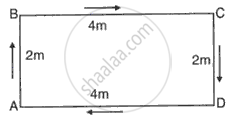
Calculate the distance and displacement in the following case: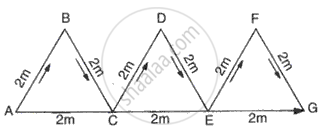
A body is moving along a circular path of radius r. What will be the distance and displacement of the body when it completes:
`(3/4)` th of a revolution
A car starts from rest and moves along the x-axis with constant acceleration 5 ms–2 for 8 seconds. If it then continues with constant velocity, what distance will the car cover in 12 seconds since it started from the rest?
Obtain a relation for the distance travelled by an object moving with uniform acceleration in the interval between 4th and 5th seconds.
