Advertisements
Advertisements
प्रश्न
A body moves along a circular path of radius r. When it completes three complete rounds, what is the ratio of distance covered to its displacement?
Advertisements
उत्तर
As after completing 3 revolution in circular motion the displacement is = 0.
so the ratio of distance covered to the displacement is infinite.
APPEARS IN
संबंधित प्रश्न
Clarify the difference.
Distance and displacement
The following table gives the displacement of a car at different instants of time.
| Time (s) | 0 | 1 | 2 | 3 | 4 |
| Displacement (m) | 0 | 5 | 10 | 15 | 20 |
- Draw the displacement-time sketch and find the average velocity of the car.
- What will be the displacement of the car at (i) 2.5 s and (ii) 4.5 s?
A car travels a distance 100 m with constant acceleration and average velocity of 20 ms-1. The final velocity acquired by the car is 25 ms-1.
Find
(i) The initial velocity.
(ii) Acceleration of the car.
A motorbike running at 90 kmh−1, is slowed down to 54 kmh−1 by the application of brakes, over a distance of 40 m. If the brakes are applied with the same force, calculate
- total time in which bike comes to rest
- total distance travelled by bike.
Under what condition is the displacement of a body equal to the distance traveled by it?
The graph shows how the velocity of a scooter varies with time in 50 s.
Work out: The distance traveled in 10 s, 20 s, and 50 s.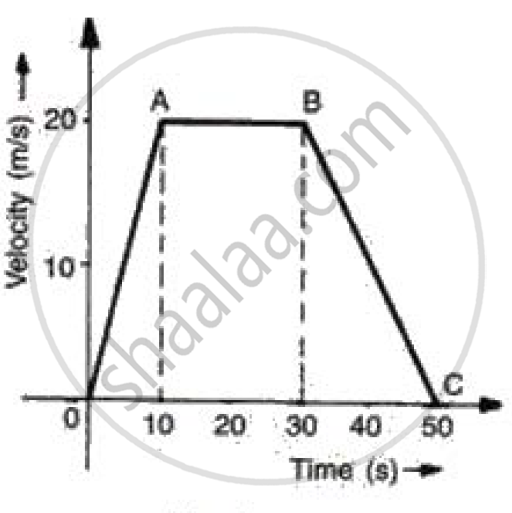
The table below shows the distance travelled by two vehicles A and B during each second:
| Time (s) | 0 | 1 | 2 | 3 | 4 | 5 | 6 | 7 |
| Distance travelled by A (m) | 0 | 20 | 80 | 180 | 240 | 300 | 360 | 420 |
| Distance travelled by B (m) | 0 | 10 | 40 | 90 | 160 | 250 | 360 | 490 |
Give the value of the velocity at which they are meeting
A man leaves his house at 6.30 a.m. for a morning walk and returns back at 7.30 a.m. after covering 4 km. The Displacement covered by him is ______.
Displacement can be zero but distance never.
Displacement magnitude can be greater than the distance traveled by the object.
