Advertisements
Advertisements
प्रश्न
Under what condition is the displacement of a body equal to the distance traveled by it?
Advertisements
उत्तर
If a body is moving in a straight line then the displacement of a body is equal to the distance travelled by it.
APPEARS IN
संबंधित प्रश्न
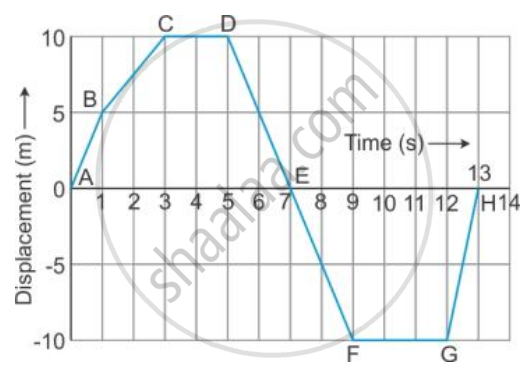
From the displacement-time graph of a cyclist given below in the Figure, find The displacement from the initial position at the end of 10 s,
A motor car slows down from 72 kmh−1 to 36 kmh−1 over a distance of 25 m. If the brakes are applied with the same force
calculate
- total time in which car comes to rest
- distance travelled by it.
Can distance covered by a body be less than the magnitude of its displacement?
Write the SI units for measurement of distance and displacement.
Can a body have negative displacement?
Name the physical quantity associated with the rate of change of displacement with time.
The table below shows the distance travelled by two vehicles A and B during each second:
| Time (s) | 0 | 1 | 2 | 3 | 4 | 5 | 6 | 7 |
| Distance travelled by A (m) | 0 | 20 | 80 | 180 | 240 | 300 | 360 | 420 |
| Distance travelled by B (m) | 0 | 10 | 40 | 90 | 160 | 250 | 360 | 490 |
Give the value of the velocity at which they are meeting
Assertion: Displacement of a body may be zero when distance travelled by it is not zero.
Reason: The displacement is the shortest distance between initial and final position.
Give some examples for vector quantity.
If the displacement-time graph of a particle is parallel to the time axis, the velocity of the particle is ______.
