Advertisements
Advertisements
प्रश्न
Displacement / Time : Velocity :: Speed / Time : ______.
Advertisements
उत्तर
Displacement / Time : Velocity :: Speed / Time : acceleration.
APPEARS IN
संबंधित प्रश्न
Is displacement a scalar quantity ?
If the displacement of an object is proportional to the square of time, then the object is moving with :
A ball moves on a smooth floor in a straight line with uniform velocity 10 m s-1 for 6 s. At t = 6 s, the ball hits a wall and comes back along the same line to the starting point with the same speed. Draw the velocity-time graph and use it to find the total distance travelled by the ball and its displacement.
A car travels a distance 100 m with constant acceleration and average velocity of 20 ms-1. The final velocity acquired by the car is 25 ms-1.
Find
(i) The initial velocity.
(ii) Acceleration of the car.
Can a body have negative displacement?
Calculate the distance and displacement in the following case: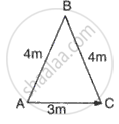
A particle is moving in a circular path of radius r. The displacement after half a circle would be
Distance is a ______ quantity.
The displacement is zero when the initial and final positions are ______.
A particle is moving in a circular pattern of radius r. The displacement after half a circle would be ______.
