Advertisements
Advertisements
प्रश्न
If the displacement of an object is proportional to the square of time, then the object is moving with :
पर्याय
uniform velocity
uniform acceleration
increasing acceleration
decreasing acceleration
Advertisements
उत्तर
uniform acceleration
We are given with the relationship that,
x = kt2
Differentiating it twice we get,
v = 2kt
a = 2k
Where,
v - velocity
a - acceleration
So, the answer is
(b) Uniform acceleration
संबंधित प्रश्न
Can displacement be zero even if the distance is not zero? Give one example to explain your answer.
State how the velocity-time graph can be used to find The distance travelled by the body in a given time
Figure given below shows a velocity-time graph for a car starting from rest. The graph has three parts AB, BC and CD.
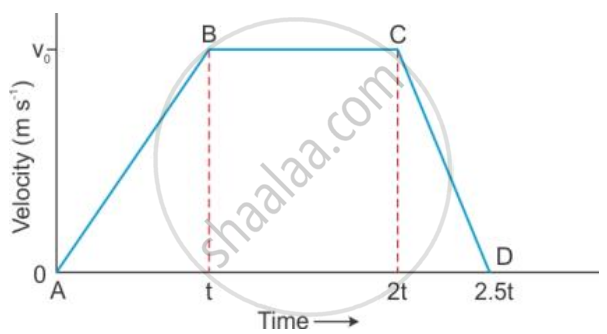
State how is the distance travelled in any part determined from this graph .
Write an expression for the distance S covered in time t by a body which is initially at rest and starts moving with a constant acceleration a.
A car travels a distance 100 m with constant acceleration and average velocity of 20 ms-1. The final velocity acquired by the car is 25 ms-1.
Find
(i) The initial velocity.
(ii) Acceleration of the car.
Draw displacement – time graph for the following situation:
When a body is moving with uniform velocity.
A motor car slows down from 72 kmh−1 to 36 kmh−1 over a distance of 25 m. If the brakes are applied with the same force
calculate
- total time in which car comes to rest
- distance travelled by it.
Can distance covered by a body be less than the magnitude of its displacement?
An object covers a distance of S meters in t seconds as follows :
| S (meters) | 0 | 8 | 20 | 20 | 16 | 10 | 0 |
| t (Seconds) | 80 | 2 | 5 | 10 | 12 | 15 | 10 |
Plot a graph, taking t on X-axis and S on Y-axis. Determine the velocity of the object at time
(i) 6 s, and
(ii) 14 s.
Displacement magnitude can be greater than the distance traveled by the object.
